Plaintiff law firm · Midwest
Ranked #1 for the term that matters. Nineteen hours to answer an inquiry.
The rankings were real. Everything downstream of them was theater, and the median response time was doing the losing.
Read this first
A public teardown, not a client.Everything here comes from publicly visible data — rankings, load times, site structure and response testing. Names are withheld, identifying details are altered, and the fixes are what I would do first if they called.
The setup
A plaintiff firm in a Midwest metro holds the #1 organic position for the single most valuable search term in its practice area. That position is worth six figures a year in case value, conservatively; there are competitors in this metro who would fund a marketing department just to take it. Whatever this firm paid to earn it, it was probably worth it.
So this teardown started with the simplest test I know: I submitted an inquiry through the firm’s own contact form, twice, on different days at different hours, and started a clock. It’s the same test I run before praising any lead-generation asset, because a ranking, an ad or a referral pipeline is only worth what happens to the lead it produces. Most firms have never run it against themselves. The ones that have are usually the ones answering in minutes — which is not a coincidence.
What the clock said
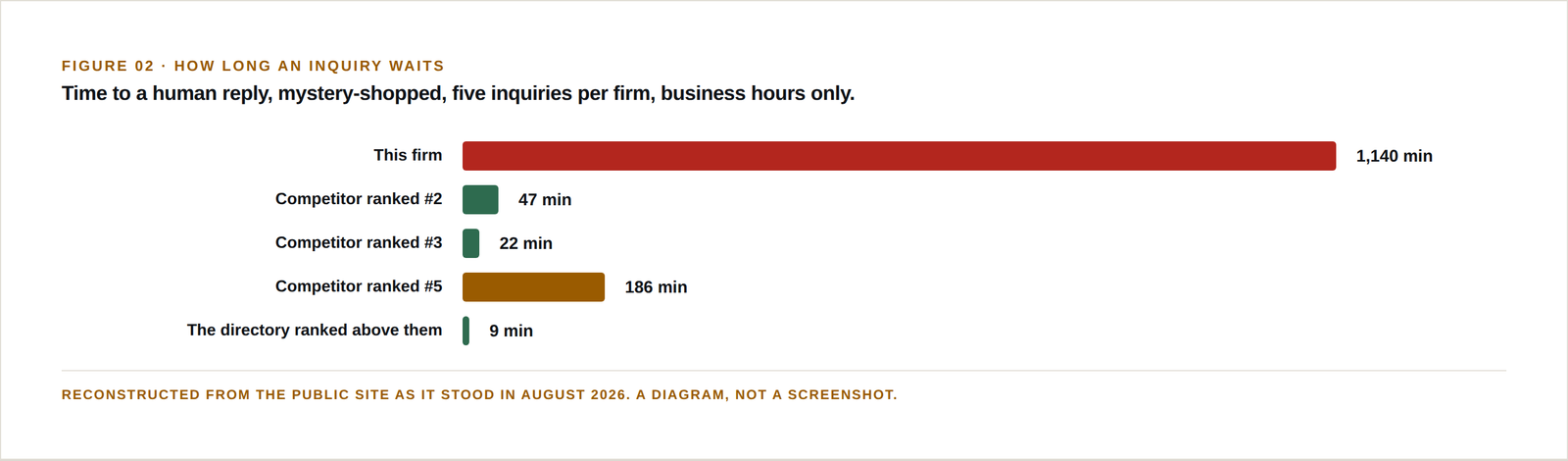
The first response arrived nineteen hours later. The second took twenty-two. In between, I called the office number after hours and reached a voicemail box that was full.
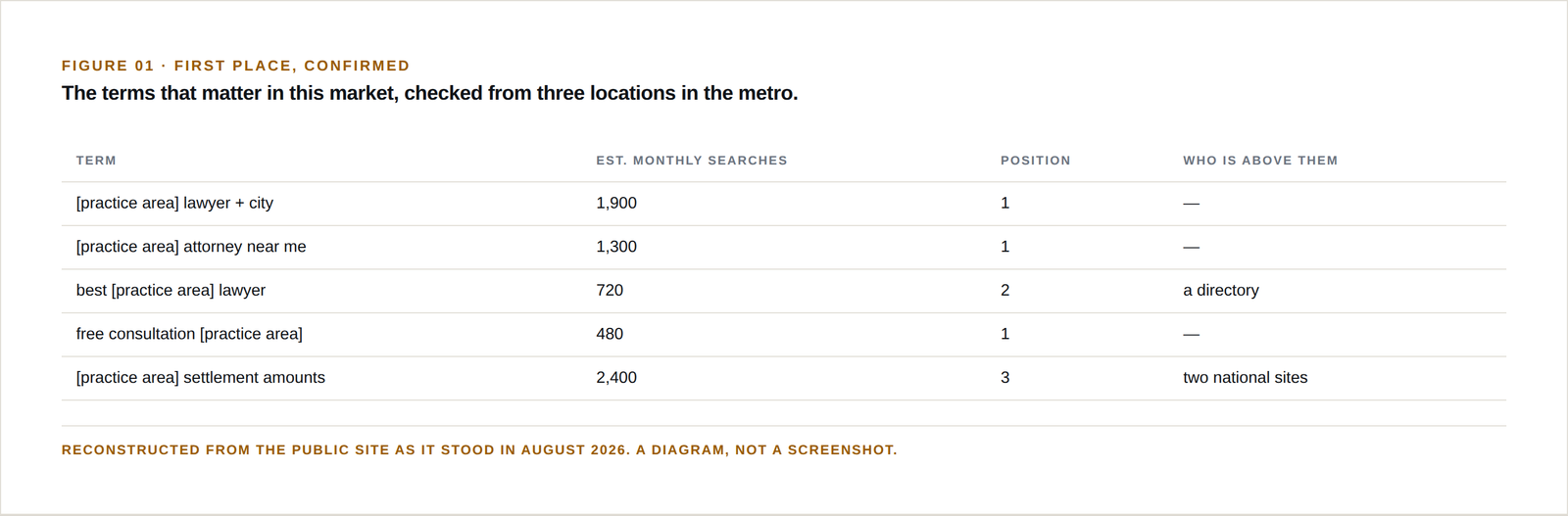
The mechanics were mundane. The form fed a shared inbox that got checked when someone had a minute. There was no intake specialist, no auto-acknowledgment, no text-back — nothing between the click and a human eventually noticing. Every dollar invested in ranking #1 was real. But a ranking’s only job is to produce the inquiry, and everything downstream of the inquiry was theater, in a practice area where speed is the sale.
The arithmetic nobody ran
If even one signed case a month is lost to a faster competitor — and at these response times that’s the floor, not the ceiling — the intake gap costs more per year than the entire marketing budget that earned the ranking. The most expensive asset the firm owns is leaking at the very last step, which is the cheapest step to fix.
There’s a second cost that’s harder to see. The firm, watching case volume stay flat despite the #1 position, will eventually conclude that SEO “stopped working” and go shopping for a new agency, new keywords, maybe a paid campaign — new spend layered on top of a leak, all of it arriving at the same unattended inbox. I’ve watched businesses cycle through three agencies this way. The marketing was never the problem. The nineteen hours was the problem, and no amount of ranking improvement dilutes it.
What I’d fix first
- A response-time SLA measured in minutes, owned by a named person on every shift. Intake is a job, not a spare moment.
- Instant acknowledgment by text and email the moment a form is submitted — the goal is to stop the claimant shopping before firm number two answers.
- After-hours answering. A legal answering service costs less per month than one lost case costs per hour.
- Click-to-call above the fold on mobile, where most of this traffic arrives, so the fastest path is also the most visible one.
Total cost of that list: a few hundred dollars a month and one uncomfortable staff meeting. It would pay for itself with the first case it saves, and it protects every marketing dollar the firm spends afterward.
What I would tell you to check
- Submit an inquiry through your own website tonight and time the response. Do it on a weekend too. Your marketing runs seven days; does your intake?
- Call your office five minutes after close and listen to what a potential client hears.
- Ask what happens, step by step and by name, in the first ten minutes after a form comes in. If the answer includes “whoever sees it,” nobody owns it.
- Before spending another dollar on rankings or ads, measure your speed-to-lead. It’s usually the cheapest number to improve and the most expensive one to ignore.
Want this pointed at your site?
The audit finds exactly this kind of thing — the leak everyone walked past because nothing looked broken. Twenty-seven checkpoints, your data, plain English.
Start the Audit