The SEO Savant
Rankings Are Vanity.
Revenue Is Sanity.
I will tell you exactly what’s wrong with your website. Then I’ll fix it.
The SEO Savant has thirty years in search. No packages, no menus, no guessing. A full diagnosis first – then the work your site actually needs, in the order it needs it.
Fixed price, $3,500. Two weeks. Yours whether you hire me or not.
A #1 ranking that doesn’t convert is an expensive trophy. I’ve been doing this since 1996 — long enough to know the difference.

Revenue first. Rankings last. Always.
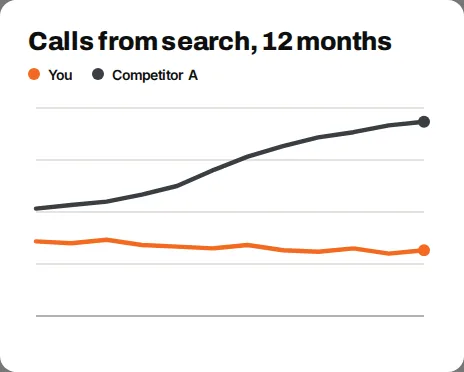
Every report I write starts with what you earned, not where you ranked. If a #1 position isn’t putting money in your account, I’ll say so — even when it’s a position I got you.
The ninety-second checkout problem.
You can buy SEO in ninety seconds right now. Ten articles, $500. Twenty backlinks, $800. A technical cleanup, $1,200. Add to cart, enter your card, done.
That model is efficient and it’s cheap and it works beautifully — for people who already know what they need.
You don’t. That’s not an insult. Knowing what a website needs is the entire skill. It’s what takes years to learn, and it’s the one thing nobody selling you a package has bothered to do.
So here’s what happens. You buy content. The content is fine. Nothing moves. Because content was never the problem — your site was fighting itself over duplicate pages, or your service areas had no pages at all, or Google had quietly stopped crawling half your catalog eight months ago.
You didn’t buy the wrong product. You bought a product before anyone asked the question.
Sixty seconds
Read the transcript
Most SEO fails for one reason. Nobody checked what was actually broken.
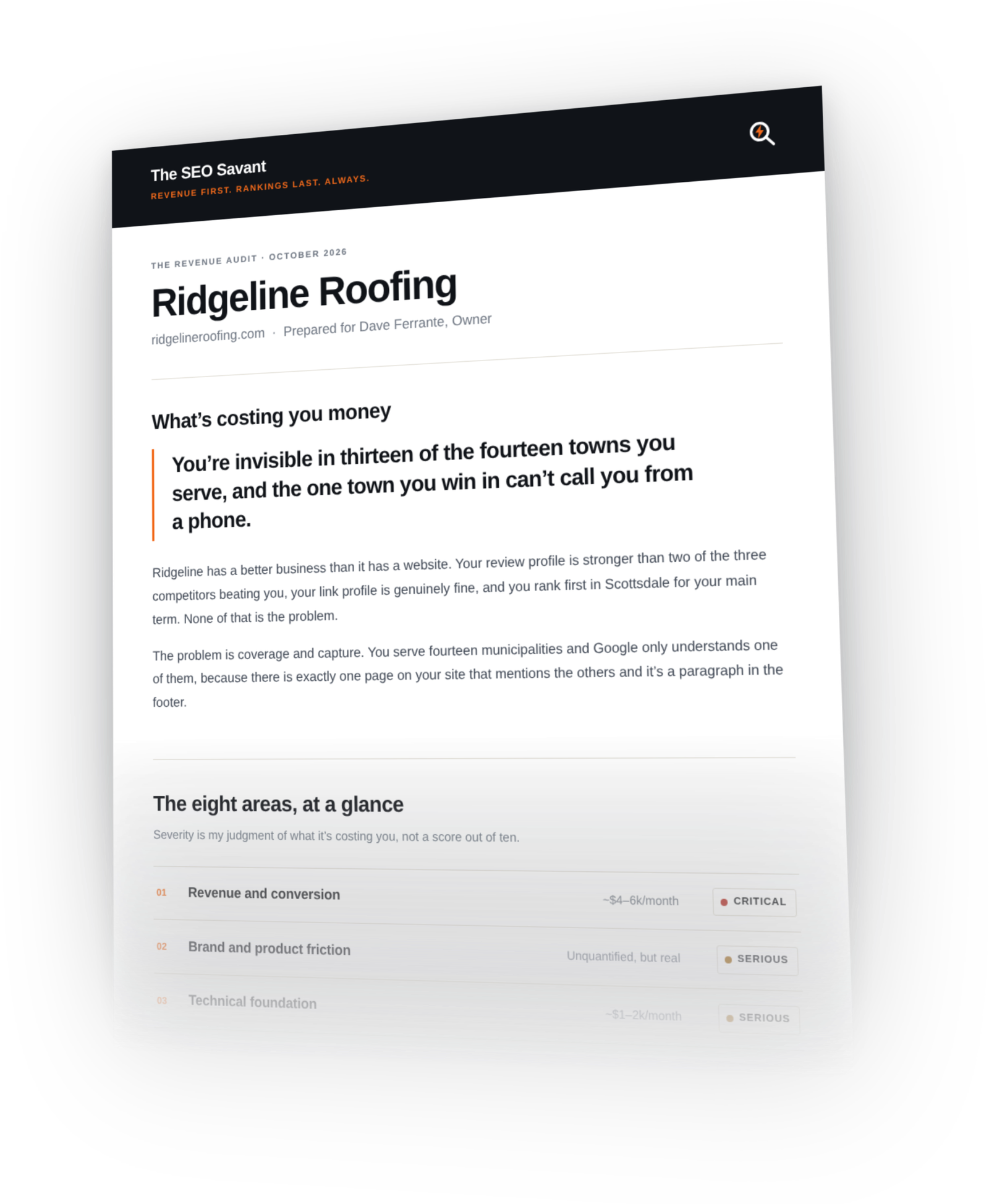
A roofer called me. He’d been paying two thousand a month for a year. Blog posts, backlinks, the usual. Traffic was up. Phone was quiet.
Took me one afternoon. He serves fourteen towns — and he had one page that listed them in a paragraph at the bottom. Every competitor beating him had fourteen pages.
He wasn’t invisible on Google. He was invisible in thirteen of his own towns.
Content was never his problem. Content is just what was on the menu.
You can buy SEO in ninety seconds right now. Ten articles, twenty links, add to cart. That works great — if you already know what you need. Knowing what you need is the entire job.
I’m Yishai. I’ve been doing this since 1996. I’ll tell you what’s actually wrong with your website, before you spend another dollar fixing the wrong thing.
Watch me find the problem in one afternoon.
A roofer paying $2,000 a month for a year. Traffic up. Phone quiet. The fix wasn’t more content — it was thirteen towns he was invisible in.
Sixty seconds is enough to show you how I think. That’s the only thing you’re actually buying.
What I do differently
I look first.
Every engagement starts the same way: I take your website apart.
Not a PDF from a crawler with 400 warnings sorted by color. I mean I go through it the way I’ve gone through websites since 1996 — architecture, indexation, content, links, local presence, competitors, conversion, and now how you show up when someone asks an AI instead of a search engine.
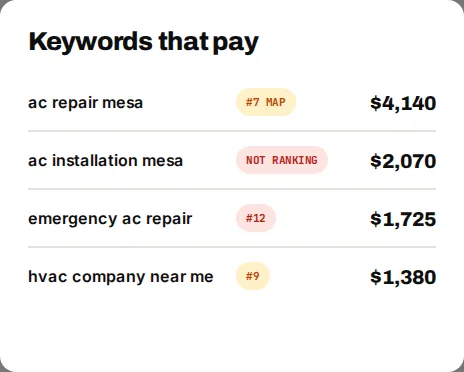
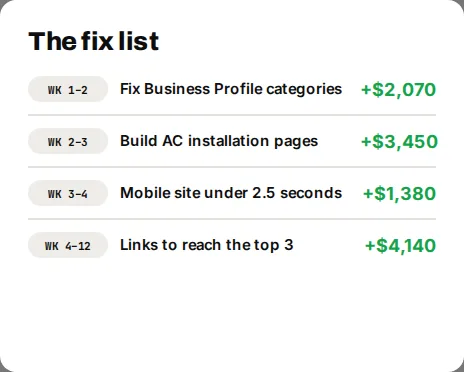
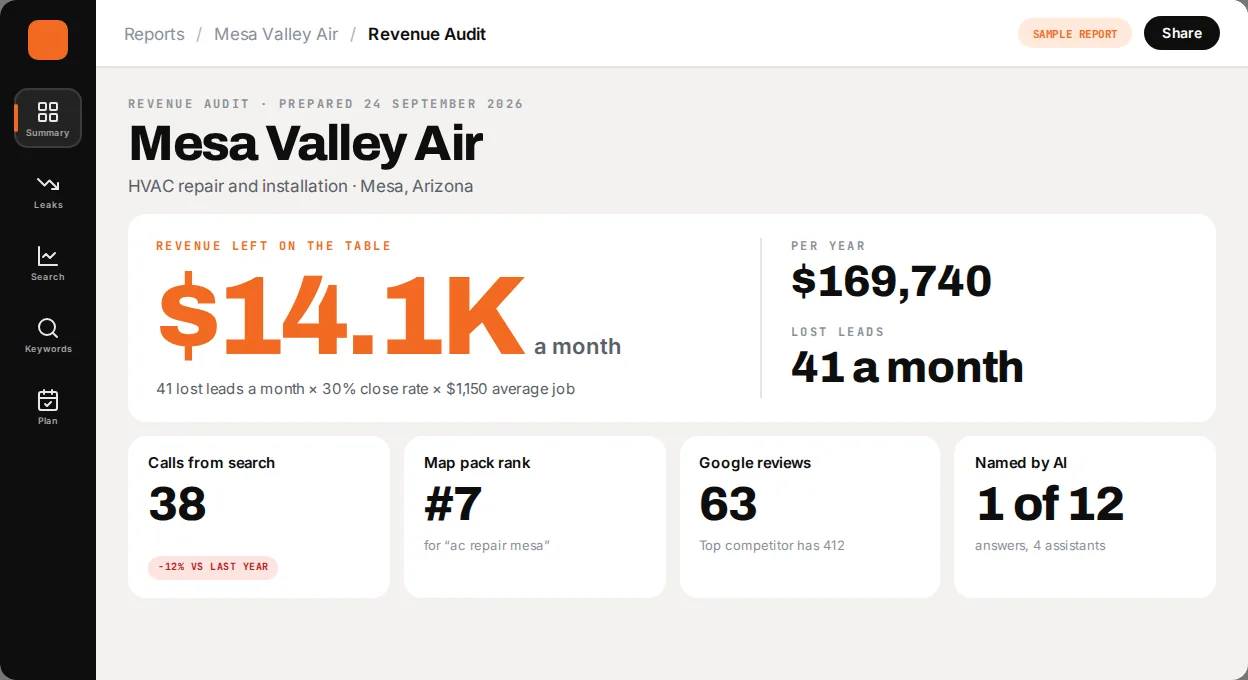
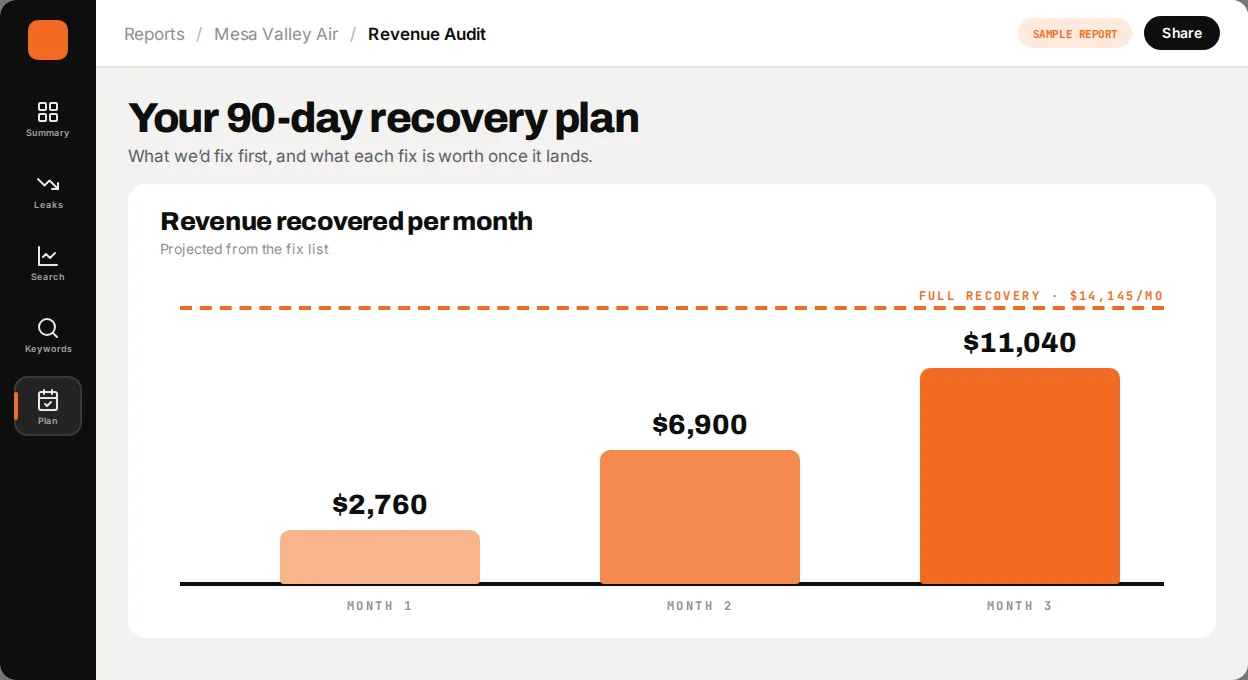
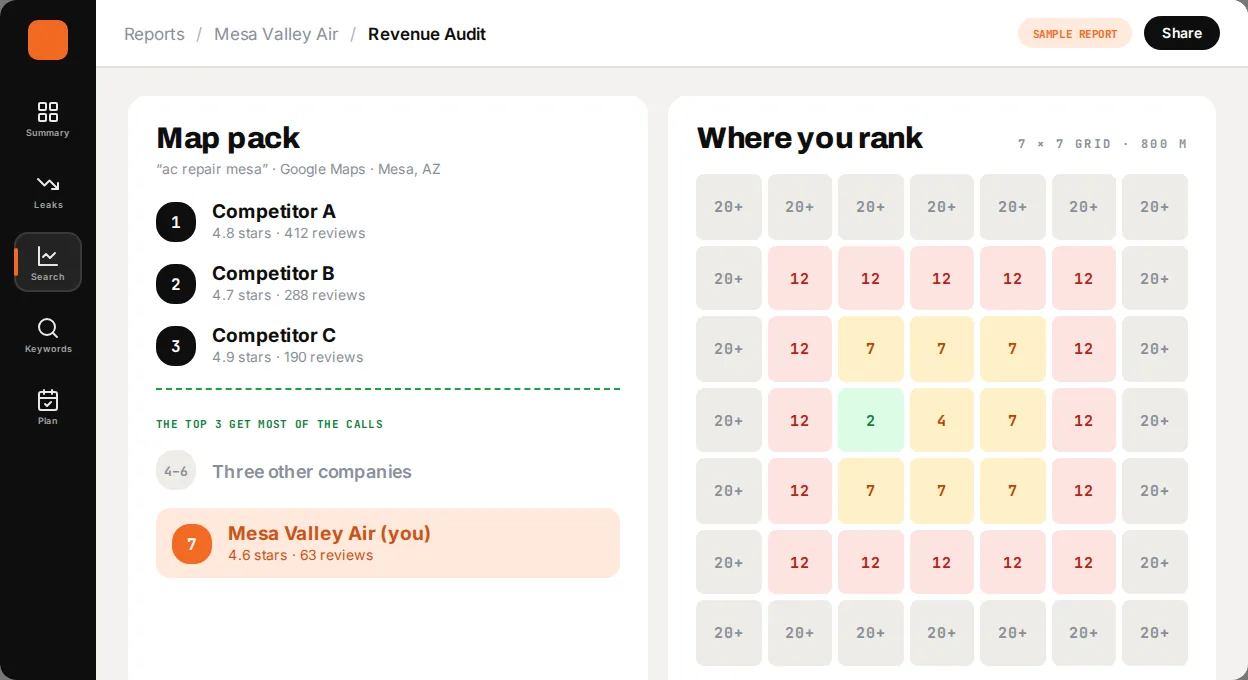
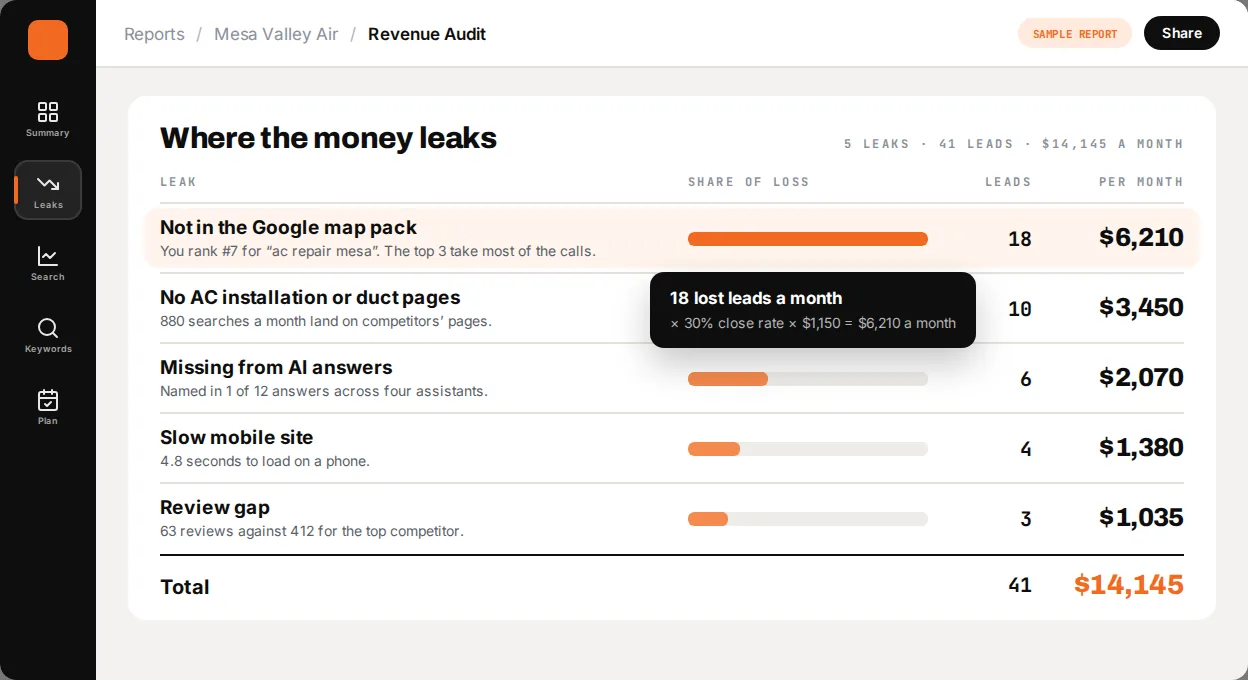
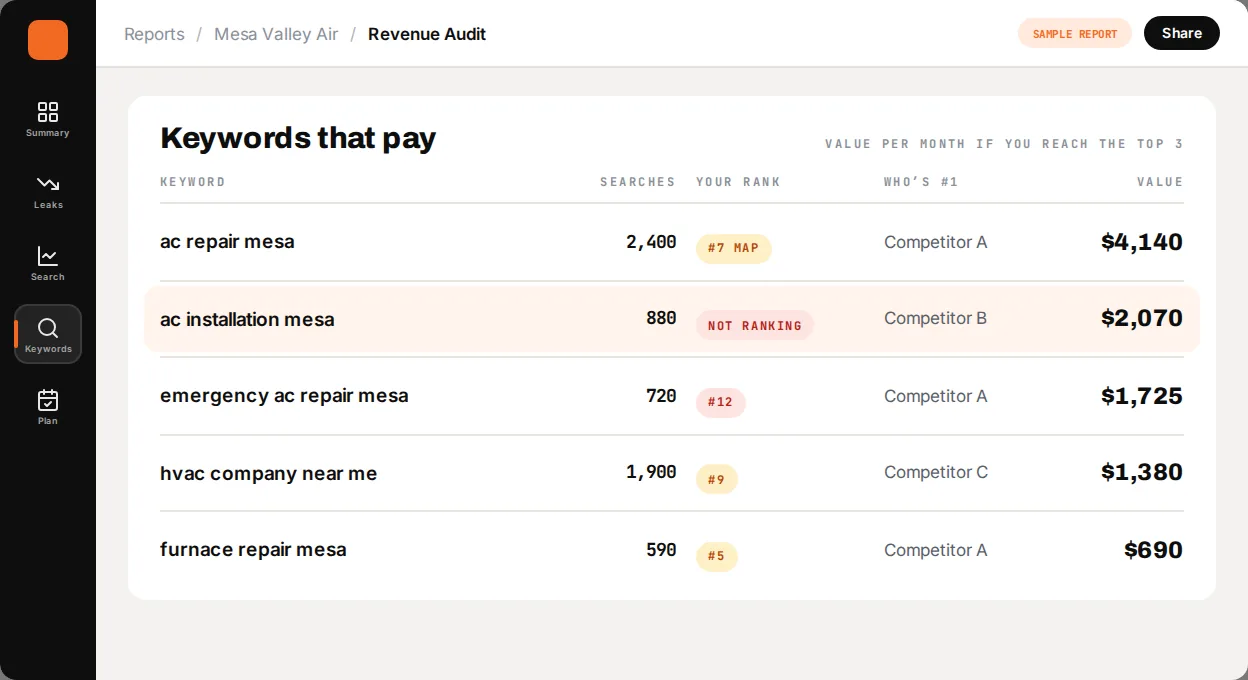
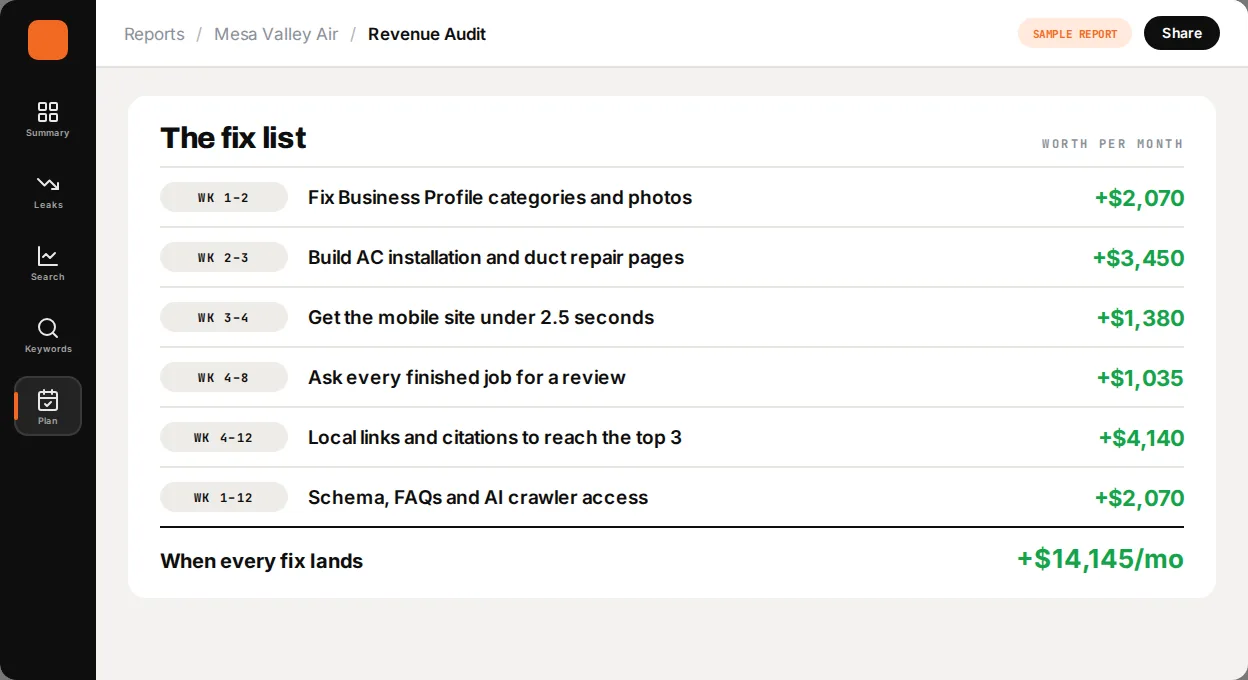
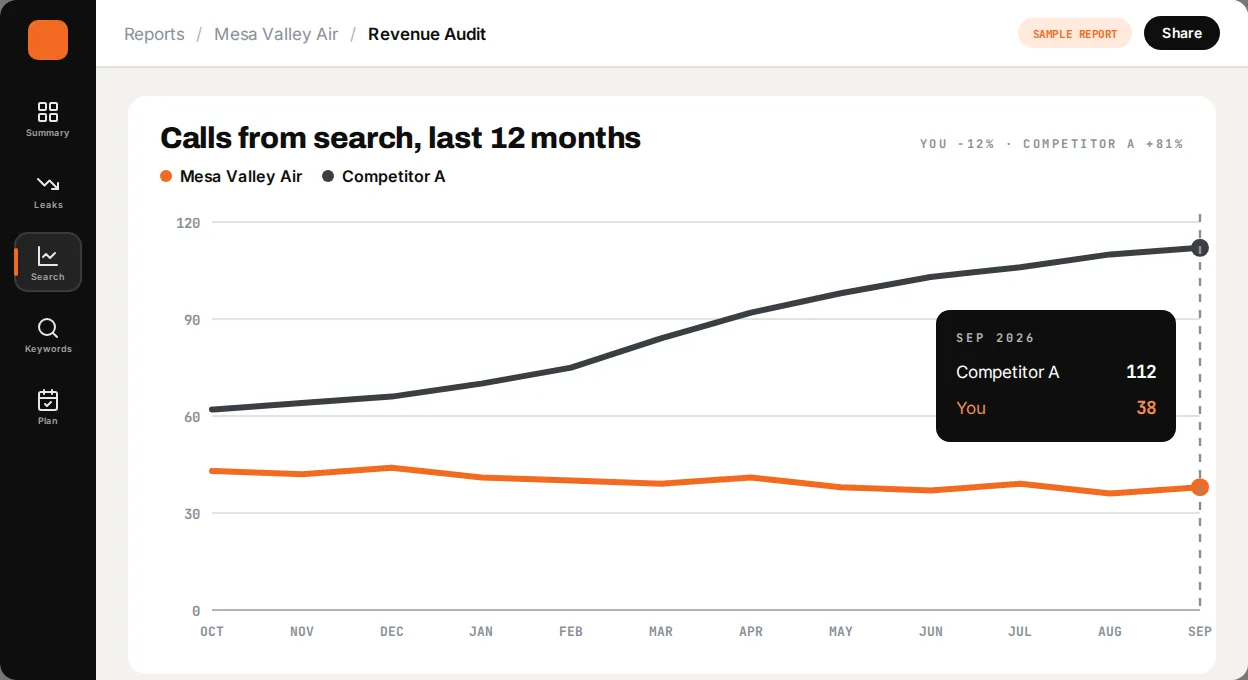
Then I hand you a document that says, in order: here is what’s costing you money, here is why, here’s my estimate of what it’s worth to fix, and here’s what I’d do first.
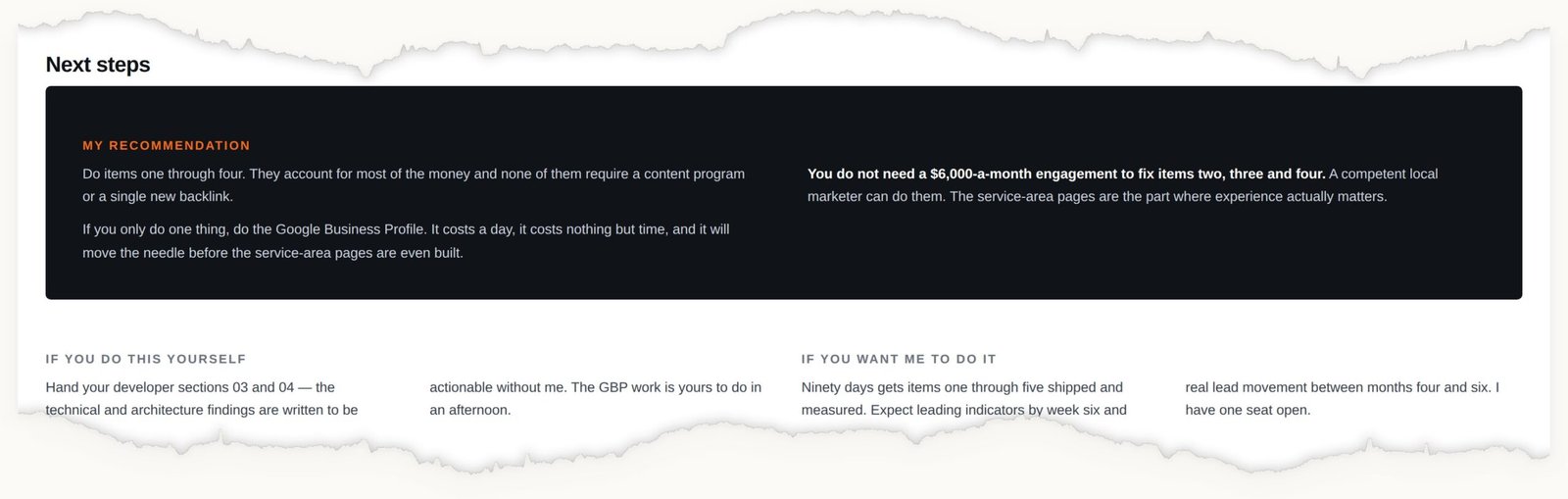
You own that document. If you take it to another agency, or hand it to your nephew, or do it yourself — that’s fine. It’s yours. I’d rather you make an informed decision to hire someone else than an uninformed one to hire me.
How it works
Three steps. The first is the one nobody else does.
01 — The Revenue Audit
I take your site apart and tell you what’s actually wrong. Two weeks. $3,500. SEO, AI visibility, conversion, and the brand and product friction nobody else looks at.
02 — The Plan
We get on a call and I walk you through it. Not a sales call — I’m reading you your own results. You’ll know what needs to happen whether you hire me or not.
03 — The Work
If you want me to execute, half the audit fee comes off your first month. From there I work the plan in priority order and report on what moved.
I can't show you my client list. Here's what I can show you.
I have been doing search work since the nineties — retail, entertainment, hospitality, a run of Fortune 500 brands and a casino floor in Las Vegas that no longer exists. Almost all of it sits under NDAs I’m not willing to break, which means the logos you’d most want to see are the ones I can’t put on this page.
So I’ll do the opposite of what most consultants do. Instead of asking you to trust a wall of testimonials, I’ll show you my actual work on businesses I’ve never been paid by, in your market, this month — and you can check every word of it yourself in about five minutes.
Twenty-one HVAC and plumbing sites. One named its owner.
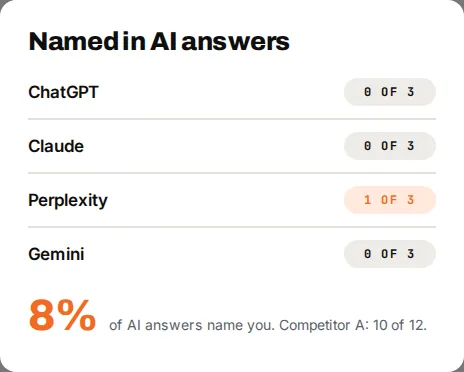
In September 2026 I opened twenty-one home-services websites across Phoenix, Tucson, Santa Fe and Las Vegas and checked every one by hand against the signals that decide whether an AI assistant will recommend a business by name.
These weren’t struggling companies. One holds a 5.0 average across 584 Google reviews. Another has been trading since 1968. Nearly all of them are close to invisible to ChatGPT, Perplexity, Gemini and Claude — and for the same short list of reasons.
Twenty-one sites reviewed manually in September 2026 across four markets. Findings describe what was publicly visible on each site at the time of review. Counts: one site named an owner or founder in full; eight published no street address (a ninth listed only a PO box); seventeen displayed reviews with no verifiable count. No company reviewed is a client, and none paid for or requested this analysis.
Thirty years of family ownership, and no family named
What I found. A Mesa plumbing company advertising three decades of family ownership, with a genuine ten-question FAQ already in place — ahead of most of its competitors. But no street address, no owner or founder named anywhere, and a reviews page carrying no rating and no review count.
Why it matters. The FAQ is the hard part and they’ve already done it — question-and-answer content is the exact shape an assistant lifts answers from. What’s missing is the entity behind it. Models attach trust to named organizations and named people; “family-owned for over thirty years” with no family named is a claim with nothing to attach to, and an unverifiable claim is skipped rather than repeated.
The fix. Name the owner. Publish the address. Put the real review count and rating on the page as a number rather than an adjective. Every one of those is a fact they already have and simply haven’t written down.
A company with no phone number on its own website
What I found. A well-established Peoria heating and cooling company — owners named, service pages written, three cities served — with no telephone number and no street address anywhere on its homepage. No FAQ. No reviews shown on the page.
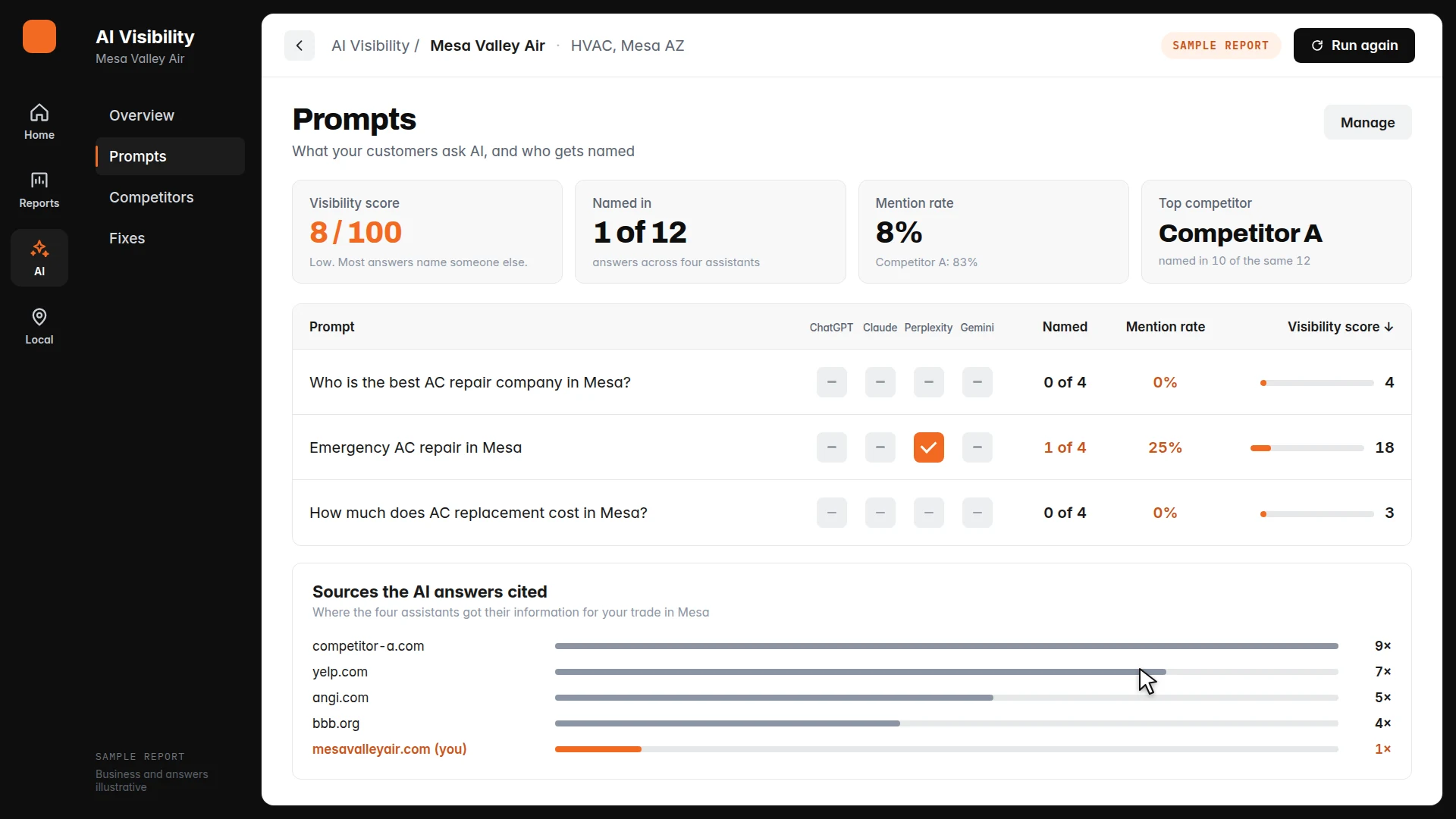
Why it matters. A language model builds an answer out of things it can confirm. Asked to recommend an HVAC company in Peoria, it needs a business name it can tie to a location and a way for the customer to make contact. With neither present, this company is not a weak candidate for that answer — it isn’t a candidate at all, and the recommendation goes to whoever published their address.
The fix. Full name, address and phone in the footer of every page, matched character-for-character to the Google Business Profile. Roughly twenty minutes of work. It is the single highest-return change available to this business and it costs nothing.
Want to know what the assistants say about you?
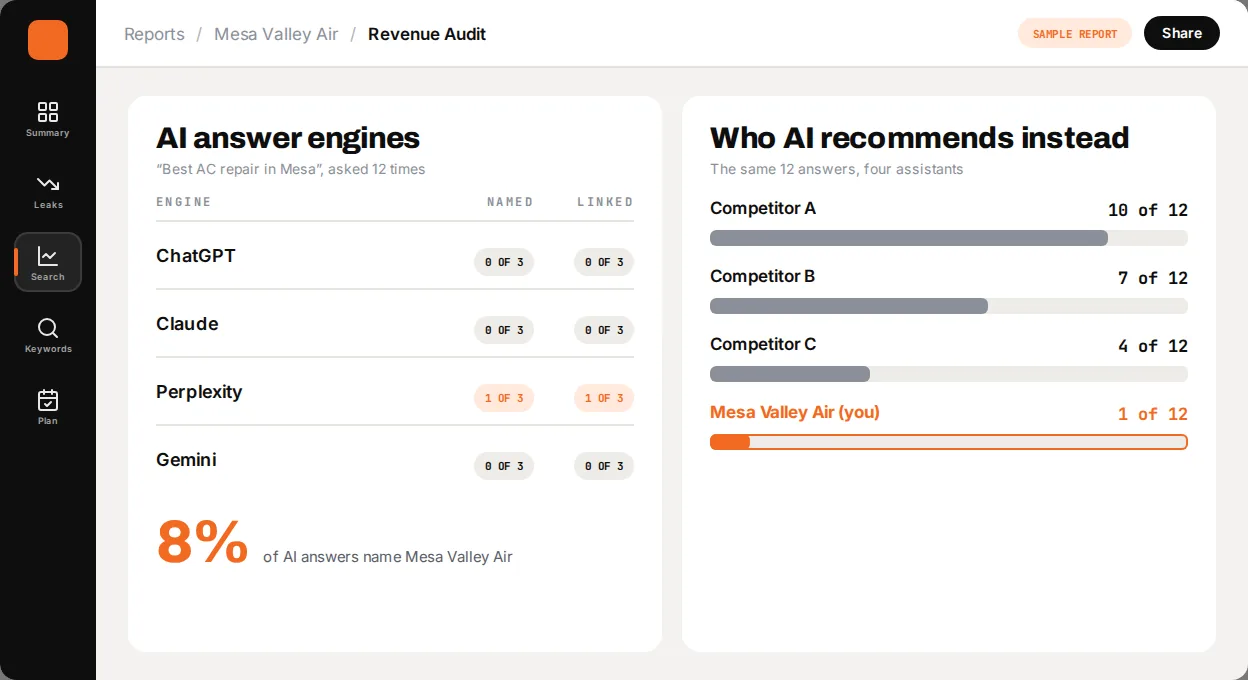
I run the twelve questions your customers actually type into ChatGPT, Perplexity, Gemini and Claude, screenshot exactly what comes back, and show you which competitors are being named instead of you and the specific reason why. One time, no subscription, and the document is yours whether or not we ever speak again.
No guaranteed rankings. No secret AI tricks. Every finding linked to evidence.
The engagement
I work with three companies at a time.
Not a scarcity tactic. A capacity fact. The product is my judgment applied to your site, and judgment doesn’t survive being spread across twenty clients.
The Engagement — $6,000/month. The audit, then I do the work. No fixed deliverable list, because I don’t know yet what your site needs and neither does anyone who hasn’t looked at it. Ninety days, then month to month.
When the three seats are full, the audit is still open — and plenty of people take it to their own team.
Included, not an upsell
Every ninety days, I diagnose you again.
The plan that was right in January is rarely still right in April. Your competitors move, Google moves, and once you’ve fixed the old constraint the constraint shifts somewhere new.
So I re-audit from scratch every quarter and reset the priority list against what’s true now.
Most agencies never do this. They build a checklist in month one and run it until you cancel — because their delivery model depends on doing the same thing for every client every month. Mine depends on being right about yours.
Pricing
Two prices. Both on this page.
No quote form. No ‘packages starting from.’ No discovery call to find out what it costs.
The Revenue Audit
$3,500
Two weeks. SEO, AI visibility, conversion, and the brand and product friction nobody else looks at. Your baseline captured before anything changes. A priority list with my estimate of what each item is worth.
Yours to keep whatever you do next.
The Engagement
$6,000 / month
The audit, then I do the work. No fixed deliverable list. Quarterly re-diagnosis included. One report a month, one call a month, one shared folder.
Ninety days, then month to month. Three clients at a time.
Start within 60 days of your audit and half the audit fee comes off your first month.
Multi-location businesses, franchises and large ecommerce catalogs are quoted individually — more site, more work, and I’d rather tell you that now than surprise you later.
Pass-through costs — paid placements, tools bought in your name, a subcontracted developer — billed at cost, no markup. Separate projects like a rebuild or a migration are quoted on their own.
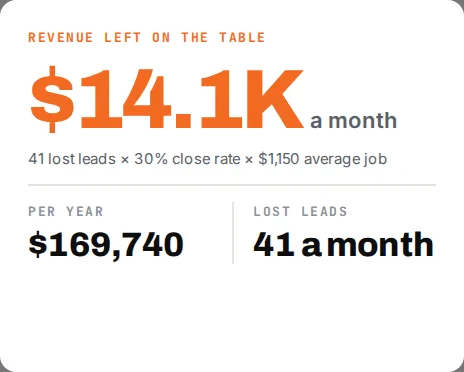
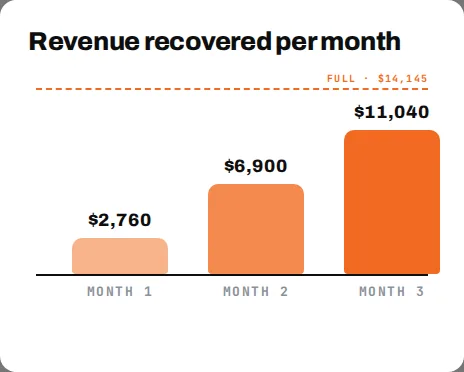
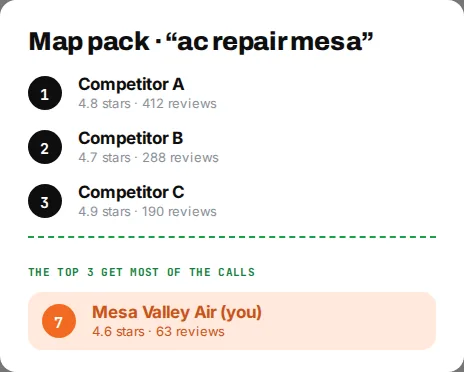
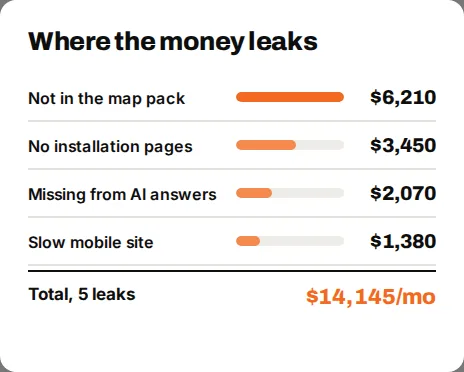
Audit excerpt
Why me
I started doing this before Google existed.
1996. Search was AltaVista and Lycos, and you ranked by stuffing keywords into a meta tag. Then Google arrived and made that worthless overnight. Then it happened again, and again — Panda, Penguin, mobile-first, the helpful content update — and now answer engines that resolve the question without sending you a click at all.
I can tell a trend from a tactic.
Most of what gets sold as ‘the new thing in SEO’ is a repackaged version of something that stopped working in 2011. I’ve seen the original.
I know what doesn't matter.
Half of what agencies bill for is theatre — work that’s easy to show on a report and has no effect on rankings or revenue. Experience is mostly knowing what to skip.
I've made the expensive mistakes.
On my own sites and on other people’s. You’re buying thirty years of me being wrong, corrected.
You talk to the person thinking.
Every time. The strategy never gets handed to a junior, which is the actual failure mode at most agencies.
The rankings don't lie
Everything you were told about SEO is wrong.
The old SEO playbook gets you crawled, not chosen. The Savant method gets you found — and clicked. Here's the difference:
27-point audit. See exactly what's blocking your rankings — no strings, no jargon.
The work
Six sites, taken apart.
Three were paid engagements, anonymized under NDA — the industry, the market size and every number are real, the name is not. Three were teardowns: public sites I diagnosed for free because nobody asked me to. The second set is the more honest half, because there was no client to please.
They were optimizing for the 30% of conversions that didn’t matter.
Six locations. Every report counted form fills. Ninety percent of their booked jobs started with a phone call nobody was measuring.
Read itCase studyGoogle was crawling 340,000 URLs to find 11,000 products.
Faceted navigation had multiplied the catalog thirty times over. Most of the store had never been indexed at all.
Read itCase studyThey ranked first and still couldn’t get anyone booked.
Top three in every market. A booking widget that rendered a blank white box on half the devices that reached it.
Read itTeardown$3,000 a month in ads, landing on a page that lost three buyers in four.
The ads were fine. The site behind them was the problem, and nobody in the building could say which half of the budget worked.
Read itTeardownRanked #1 for the term that matters. Nineteen hours to answer an inquiry.
The rankings were real. Everything downstream of them was theater, and the median response time was doing the losing.
Read itTeardownRanking for its own name, and nothing anybody searches for.
The keyword report looked healthy until you crossed out every brand term. One row was left standing.
Read itStraight answers
The questions you're actually asking.
You can. What you’ll get is output — some articles, some links, a report. What you won’t get is judgment about whether any of it applies to you. If your site’s problem happens to be the thing they sell, you’ll do fine. That’s the bet you’re making.
Because a free audit isn’t an audit, it’s a sales document. It’s produced by software in four minutes and engineered to make you nervous enough to buy a retainer. Mine takes two weeks, it’s done by hand, and it’s perfectly capable of concluding that you don’t need to hire anyone — including me.
Then $3,500 is a small price to find out whether the money you’re already spending is doing anything. In writing, from someone with no stake in the answer. If they’re doing good work I’ll tell you that too.
Depends entirely on what’s broken. Technical fixes can move things in weeks. Authority in a competitive market takes six to twelve months. I’ll give you an honest range after the audit, not before it — anyone quoting a timeline before they’ve looked at your site is guessing.
Probably, and probably not in the way you’ve been told. Getting cited by an AI is mostly downstream of things good SEOs have done for years — being crawlable, being authoritative, answering questions cleanly. There are some real new mechanics on top of that, and I audit for them. But if someone’s selling you ‘AEO’ as a separate product line, check whether they’re selling you the same work twice.
The audit is just the beginning
Why the most successful brands don't stop at the audit
The audit shows you what's broken. But the brands that own page one go deeper — they get the strategy, the execution, and the direct access to The SEO Savant that separates ranking from dominating.
Free SEO Audit ← YOU ARE HERE
27 checkpoints. Every leak, penalty risk and missed ranking found. Your unfair advantage starts here.
SEO Foundations
Full technical cleanup and on-page rebuild. Site speed, crawlability, structure and intent-matched pages — the fixes that move rankings in weeks, done for you.
Growth Engine
Monthly content engineered to rank and convert, plus authority links earned — never bought. Compounding visibility across search, maps and AI answers.
Savant Partnership
Direct access to The SEO Savant. Custom strategy, priority execution, monthly 1-on-1 growth sessions and full-funnel reporting. This is where categories get owned.
Find out what's actually wrong.
Two weeks. $3,500. A real document, written by hand, that tells you what’s costing you money and what I estimate it’s worth to fix.
Start with me within 60 days and half the fee comes off your first month. If you don’t, you still keep the answer.