Field notes · Revenue building
Your pricing page is an SEO asset and you've hidden it
Buyers search for what things cost. Most businesses refuse to answer, so a forum thread or a directory answers for them. Here is how to publish a number without committing to one.
By Yishai — thirty years in search
The search that already has a buyer attached
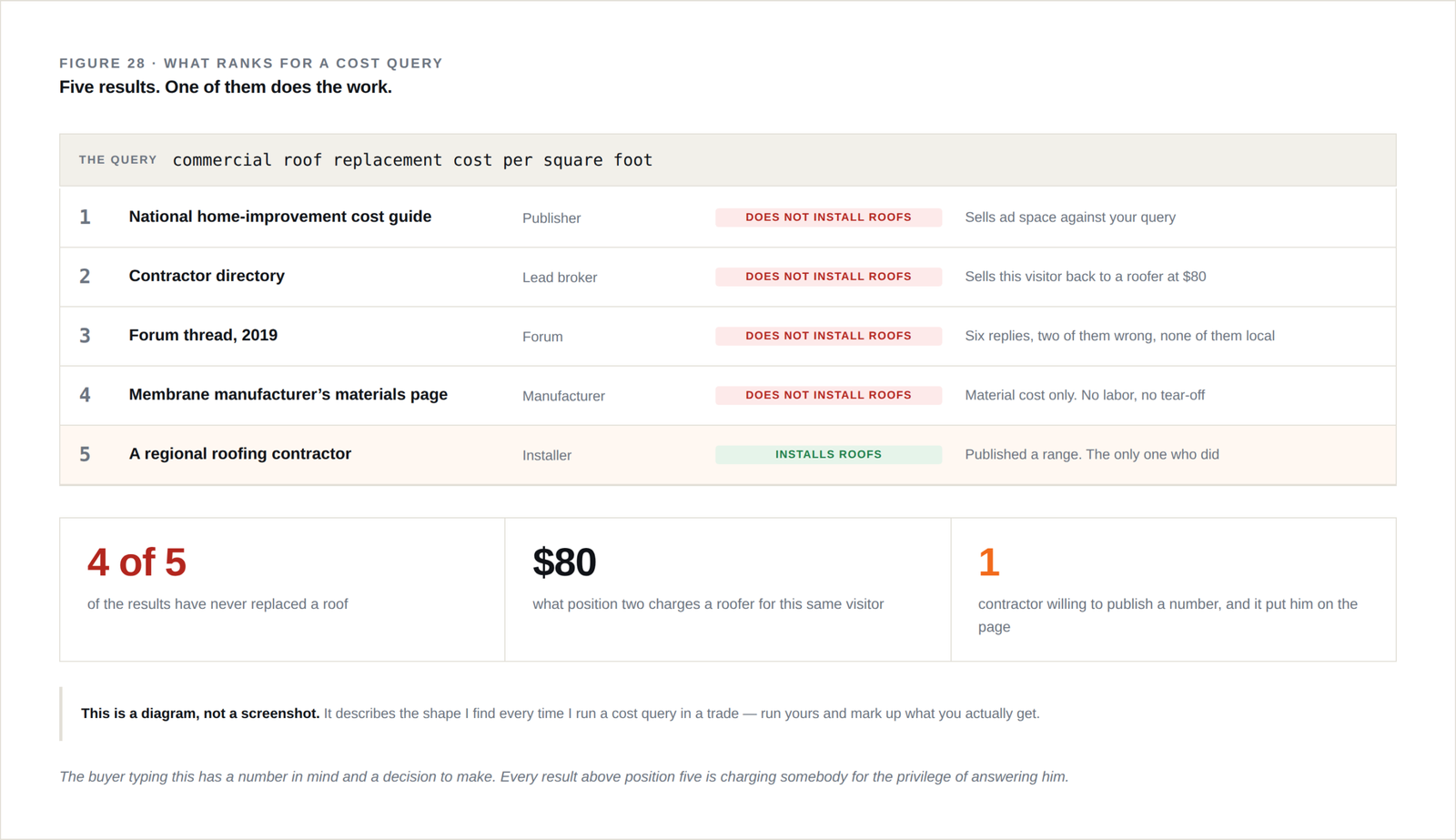
Someone types “commercial roof replacement cost per square foot” into a search box at 9:40 on a Tuesday. That person is not browsing. They have a leak, a board meeting Thursday, and an empty cell in a budget spreadsheet. That query is the closest thing to a raised hand that search produces.
Go look at what ranks for it in your category. Usually it’s a forum thread from 2019, a directory that will happily sell your own leads back to you at $80 apiece, or the single competitor brave enough to publish a range. It is almost never the specialist who does the work. The specialist decided years ago that discussing money on the internet was undignified.
I’ve run this check for something like forty businesses since 2011. The pattern holds. Cost and pricing queries carry maybe a fifth to a tenth of the volume of the head term, and they convert three to eight times better. A water damage restoration client in Tulsa ended up with “water damage restoration cost” producing 6% of organic sessions and 31% of form fills. They published that page reluctantly. It took me six weeks of pushing and one uncomfortable meeting.
Low volume, low competition, buyer already holding a purchase order. That is the entire argument. The reason the page is winnable is the same reason you haven’t built it: everyone in your category is frightened of it.
The two fears, and what they are actually about
Fear one: a competitor reads the number and undercuts it. Fear two: it depends, so any number published is a lie.
The first fear is mostly fiction. Your competitors already know your pricing. They’ve been quoted by you through a friend’s company, they’ve sat across from your proposals in procurement bake-offs, they’ve hired three of your ex-employees. In thirty years I have never found a business that lost measurable share because a rival read a web page. I have repeatedly found businesses losing forty inquiries a month to a directory publishing ranges somebody invented.
The second fear is honest. It is still not a reason for silence. “It depends” means variables exist. Fine. Name the variables. A buyer doesn’t need a quote. A buyer needs to know whether you are a $4,000 problem or a $40,000 problem, because that determines whether they call you or their brother-in-law.
Here’s the test I give clients. Pull the last twenty invoices. Sort by total. Read off the 10th percentile and the 90th percentile. You now have a range that is true, defensible, and derived from your own accounting rather than your nerves. If the spread between those two numbers is 30x, you don’t have a pricing problem. You have a productization problem, and hiding the page won’t fix it.
Name the drivers, with direction and magnitude
The part buyers actually want isn’t the number. It’s the mechanism. Tell them what pushes the price up and by roughly how much, and they will do the arithmetic themselves and arrive at a figure they trust more than one you handed them.
A bookkeeping firm I worked with in 2023 published this: base engagement $650 a month for one bank account, one credit card, under 150 transactions. Then four drivers. Each additional bank or card account, plus $75. Inventory, plus $200 to $400 depending on SKU count. Multi-state payroll, plus $150 per state. Cleanup of prior-year books, one-time, $95 an hour, typically 6 to 20 hours. Any prospect could now build their own estimate in ninety seconds.
That page took an afternoon to write. It ranked inside seven weeks for “bookkeeping services cost small business” and a dozen variants, because nobody else in their metro had written anything except “contact us for a custom quote.”
Three to five drivers is the right count. Fewer looks evasive. More looks like a tax form. Give a direction and a magnitude for each. Round the numbers. Nobody believes $647.
The structure that answers without committing
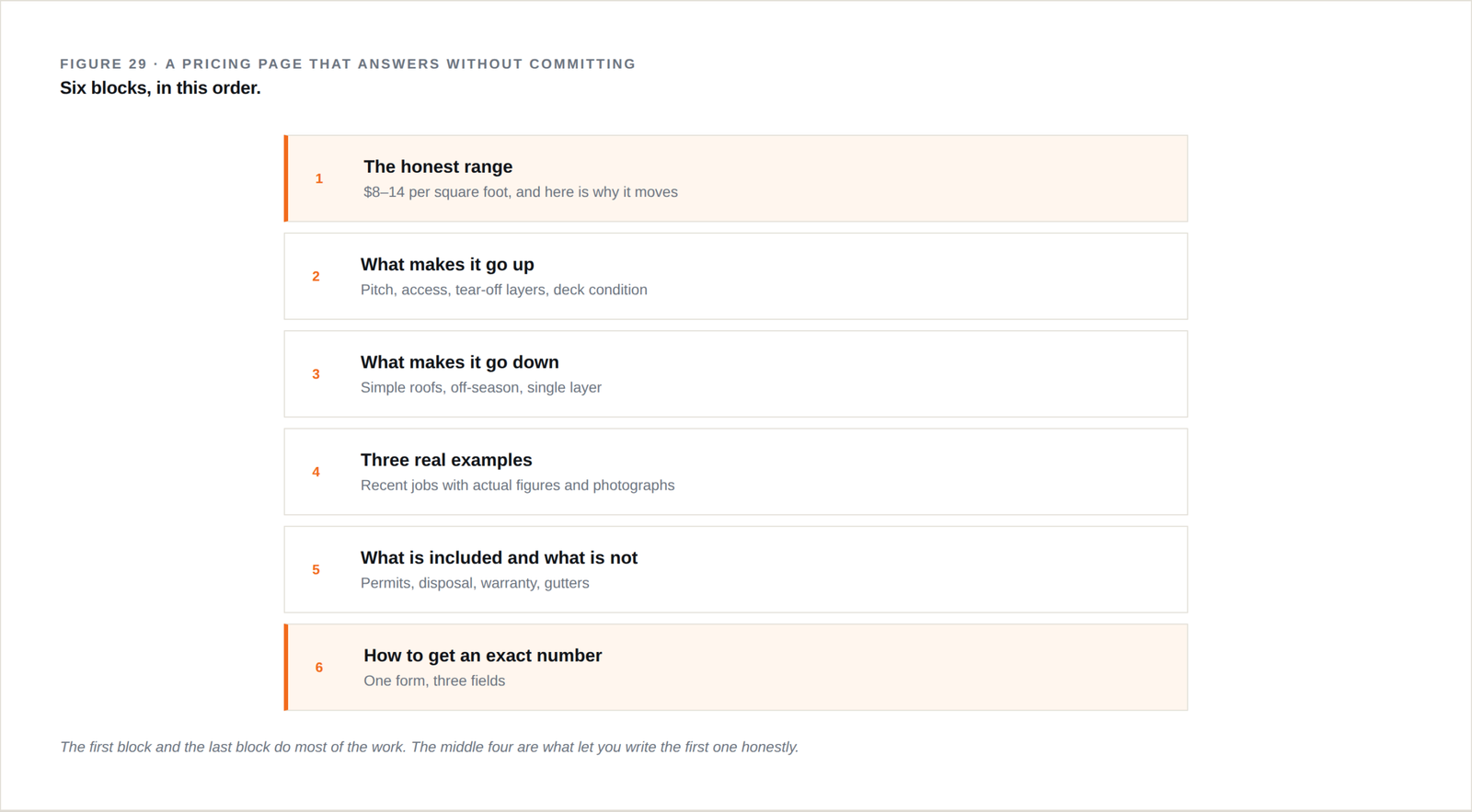
Six blocks, in this order.
Range, above the fold, in plain digits. “Most projects land between $18,000 and $47,000.” Not a starting-at number. Starting-at numbers are read as bait and they poison everything below them.
What moves it. The three to five drivers, each with a direction and a dollar or percentage magnitude.
One worked example. A real job, anonymized. “A 12,000 square foot warehouse in Broken Arrow, TPO replacement, two skylights, tear-off of one existing layer: $214,000, completed in nine days.” A single concrete case does more work than four paragraphs of qualification.
What’s included and what isn’t. Permits. Disposal. Warranty length. The three items competitors quietly leave out and then invoice for later. Naming those makes you the trustworthy one for free.
Who this is wrong for. Say it plainly: “If your budget is under $8,000, I’m the wrong call, and here’s the type of firm that isn’t.” This costs you nothing. Those people were never going to buy.
How to get an exact figure. What information you need, how long it takes, whether it’s free.
What happens to your inbox
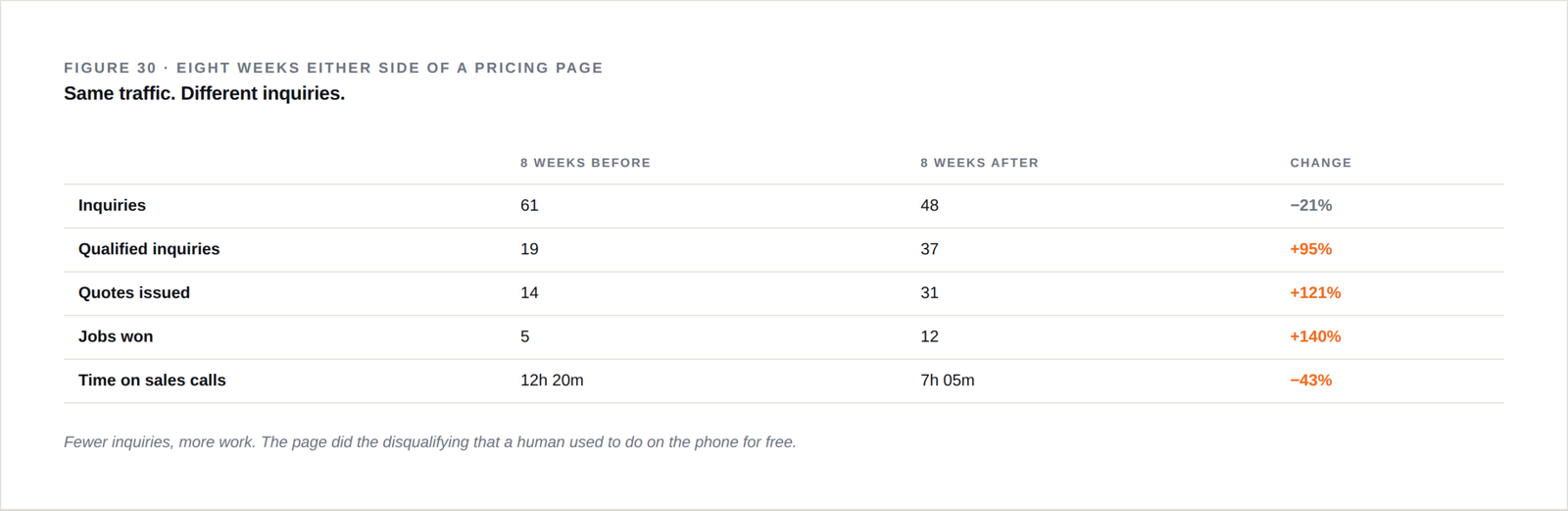
Publishing price changes the composition of your inquiries, and the first month feels like a punishment.
The bookkeeping firm’s inquiry volume fell 38% in the eight weeks after that page went live. Their proposal-to-close rate went from 22% to 61%. Total new monthly recurring revenue rose. The owner had been spending roughly nine hours a week on discovery calls with people who fainted at the first number. That’s a workday. He got it back.
That is the trade. Fewer conversations, better ones. If you’re paid by the lead, publishing price is against your interest. If you’re paid by the deal, it is the cheapest qualification mechanism available.
Fewer inquiries that close is not a smaller business, it’s the same business with the wasted hours removed.
When staying quiet is genuinely correct
There are three cases, and only three that I accept.
True bespoke enterprise work, where the deal is negotiated per client and shaped by procurement, volume commitments, and a rate card under NDA. Publishing a number there is meaningless. Publish the methodology instead. What you charge for, how it scales, what a typical engagement floor looks like.
Regulated or legally constrained pricing. Some insurance-adjacent work, some healthcare, some jurisdictions where posted rates create obligations. Talk to counsel, not to me. Then publish whatever you are permitted to publish, which is nearly always more than zero.
Genuine market-rate volatility, where materials move weekly. Publish the formula and the date. “As of March, framing lumber is running $X per board foot and that’s about 22% of a typical build.” Stale numbers are worse than none, so date the page and set a calendar reminder to touch it every quarter.
Everything else is fear wearing a business suit. The buyer is going to find a number today. The only decision you control is whether it’s yours.
Want this pointed at your site?
The Revenue Audit tells you what’s actually wrong in two weeks. $3,500, and it’s yours whatever you decide to do next.
