Skip to content
Plumbing

Your emergency pages are written for people who aren’t in an emergency.

Residential and commercial plumbing. A full diagnosis first, then the work your site actually needs, in the order it needs it.

Two weeks. Yours to keep whatever you decide to do next — including hiring someone else.

Run this tonight

The fifteen-minute test that predicts your busiest month.

Here’s something you can do tonight, free, that will tell you more about your marketing than any report you’re paying for: experience your own emergency funnel the way a customer does. Almost no plumber ever has. You built the business, you know the number by heart, and you have never once stood in a hallway at 2 a.m. with water coming through the ceiling, searching for yourself.
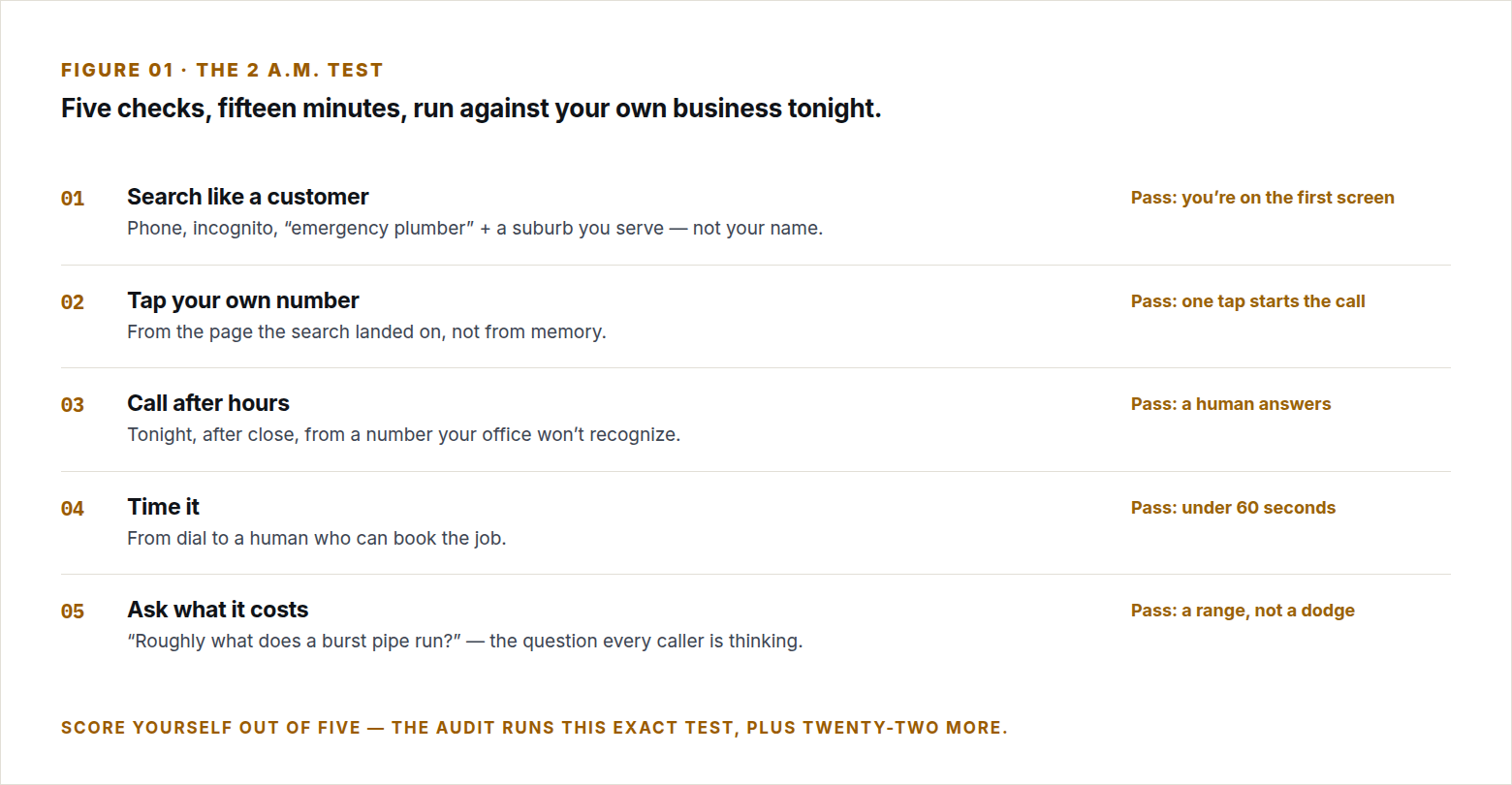
The 2 a.m. test
The 2 a.m. testFive checks, fifteen minutes, no tools required. Most shops I audit score two out of five.

Score yourself honestly. Five out of five means your emergency funnel works and your marketing money should go elsewhere — genuinely, I’ll tell you the same thing in an audit. Two out of five means every dollar you spend driving emergency traffic is pouring into a bucket with three holes in it, and the cheapest marketing you’ll ever buy is fixing the bucket. The checks aren’t sophisticated. That’s the point — neither is the customer at 2 a.m.

Search intent

A burst pipe doesn’t search like a bathroom remodel.

Most plumbing websites chase one keyword — “plumber [city]” — and ignore the way people actually type when something goes wrong. Homeowners don’t search for solutions; they search for symptoms. Nobody types “licensed plumbing contractor.” They type what they’re looking at: the water heater leaking from the bottom, the bill that doubled, the drain that smells. Every one of those symptoms is a search, every search is a page, and almost no plumber in your metro has built them.
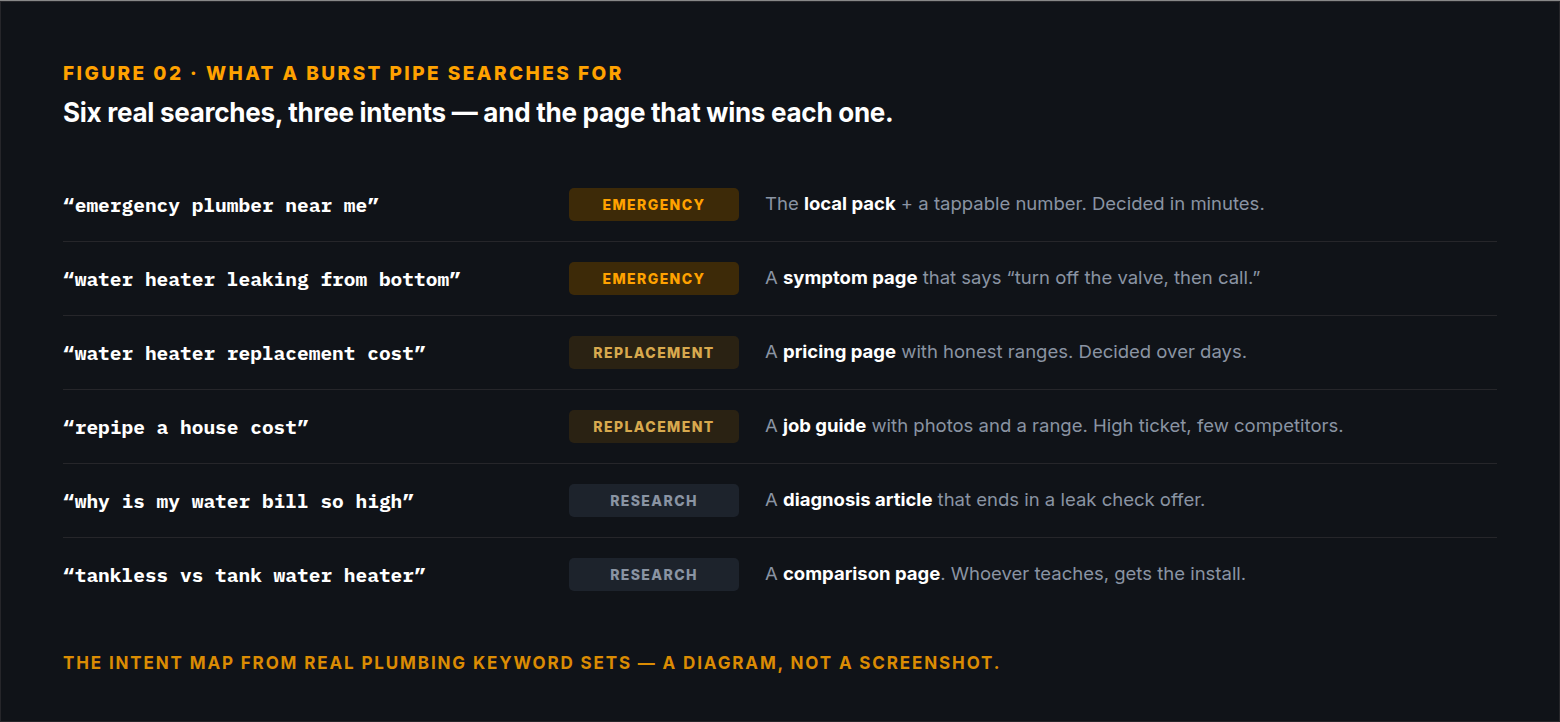
What a burst pipe searches for
What a burst pipe searches forEmergency searches are won on the map. Replacement searches are won with honest pricing. Research searches are won by whoever teaches — and teaching earns the install.

The symptom pages are the underpriced asset here. A page called “water heater leaking from the bottom — what to do first” that tells the homeowner to shut the cold-water valve before asking for the call is doing two jobs: it ranks for a search with almost no competition, and it walks into the house already trusted. The remodel-and-research searches are slower money, but they’re where the $8,000 repipes come from — and the plumber who wrote the honest cost guide gets that call without bidding against anyone.

The missed-call tax

The most expensive sound in plumbing is a phone nobody answers.

Everything on this page — rankings, pages, the map — exists to make one thing happen: the phone rings. Which is why the leak I find most often in plumbing audits isn’t on the website at all. It’s what happens to the call. An emergency caller who hits voicemail doesn’t leave a message; they call the next plumber on the list, and the job is gone in the ninety seconds your marketing worked so hard to win.
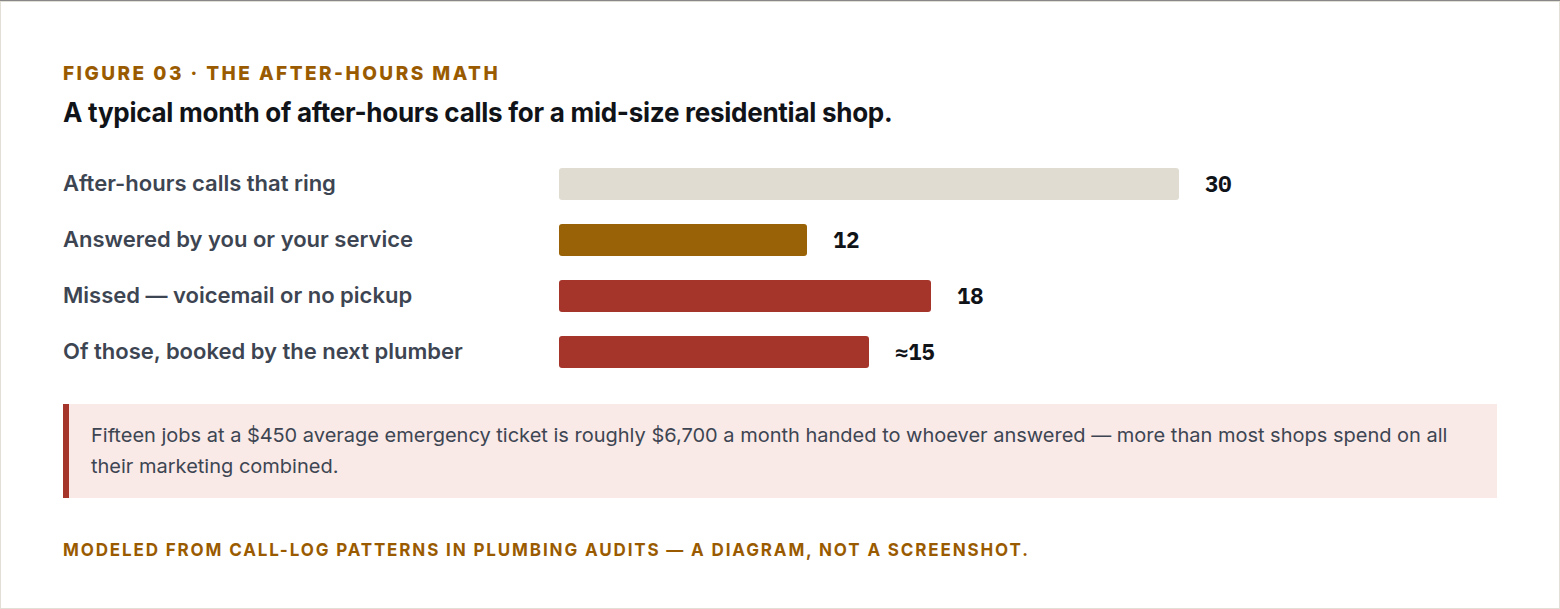
The after-hours math
The after-hours mathThirty after-hours rings, twelve answered. The eighteen missed calls are worth more than most shops’ entire marketing budget.

An answering service that can book a job costs a few hundred dollars a month. Against the figure above, it’s the highest-ROI line item in the trade — and it also quietly improves your rankings over time, because answered calls become completed jobs, completed jobs become reviews, and reviews are the prominence signal the map runs on. I wrote about what slow answers cost in a very different industry in my law firm teardown — the zeros are bigger there, but the physics are identical.

Two businesses

Your website is doing one job. You’re selling two.

Most plumbing shops run residential and commercial work off the same trucks — and the same homepage. But the property manager who needs backflow testing across nine buildings is not searching like the homeowner with a flooded laundry room, isn’t deciding on the same clock, and isn’t impressed by the same proof. One website has to win two completely different hires.
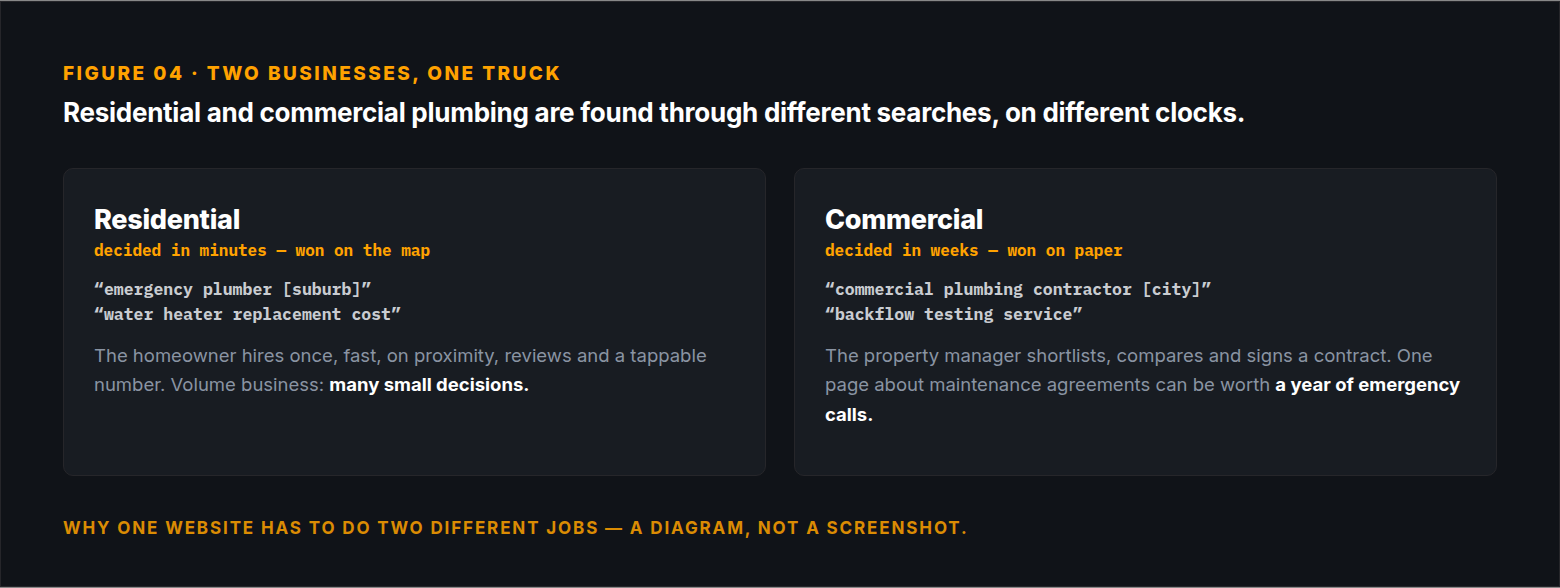
Two businesses, one truck
Two businesses, one truckResidential is many small decisions won in minutes on the map. Commercial is a few large decisions won over weeks, on paper.

The commercial side is usually the bigger miss, because it’s hiding behind quieter searches — “commercial plumbing contractor,” “backflow testing,” “plumbing maintenance agreement” — that almost nobody in a given metro has built real pages for. A single page that speaks property-manager: response-time commitments, compliance paperwork, references from buildings like theirs — can land contracts that out-earn a whole season of emergency calls. The Revenue Audit maps both sides of your market and tells you which one is leaking more.

The cold read

I already know three things about your website.

I haven’t seen it yet. I’m still usually right.

One: your emergency pages read like brochures.

Somebody standing in two inches of water at 11pm is not reading about your company history or your commitment to quality. They want a phone number, a response time, and whether you are actually awake. Most emergency plumbing pages bury all three under three hundred words of nobody-reads-this.

Two: your phone number is not tappable.

Most of your traffic is mobile and most of your conversions are calls. If the number is an image, or plain text, or sitting below the fold, you are losing people who had already decided to hire you. This is a ten-minute fix that regularly outperforms a quarter of content.

Three: you rank in one town and serve nine.

Plumbing search is intensely local and intensely immediate. Nobody scrolls to page two at 11pm. If you have no page and no profile signal for the other eight municipalities, you are not competing there at all — you are absent.

Emergency plumbing is the least forgiving search there is. You are either the first call or you are not in the conversation.

The part nobody audits

Repair pays the bills. Replacement pays for the year.

Most plumbing sites optimize hard for emergency repair, which is the right instinct — it is where the volume is. Then they have nothing for water heater replacement, repiping, sewer line work or softener installs, which is where the margin is.

Those are researched purchases with a longer window and far less competition. A plumber ranking for emergency work and invisible for replacement is leaving the profitable half of the business on the table, and it is usually the easier half to win.

The math

What this has to be worth.

At $6,000 a month, this needs to produce a steady handful of extra service calls plus the occasional replacement job. For most plumbing companies that is a low bar — but it is still a bar, and the audit will tell you honestly whether your numbers clear it.

Straight answers

What plumbers ask me.

In one town, probably. Check it from a phone with location set to each municipality you serve. Most plumbers are shocked by what they find three towns over.

Good. Now find out how many of those calls convert versus the ones you answer yourself, and whether the after-hours number is even tracked. In most plumbing companies nobody can answer that, which means nobody can improve it.

Rarely, in the way it gets sold to you. Blog posts about drain maintenance do very little. Pages that answer replacement and cost questions do a great deal. The distinction is intent, and it is the difference between a content program and a waste of a year.

Find out what’s actually wrong.

Two weeks. $3,500. SEO, AI visibility, conversion, and the brand and product friction nobody else looks at.

Start with me within 60 days and half the fee comes off your first month. I work with three companies at a time.