Skip to content
The Revenue Audit

Read one before you buy one.

This is a complete Revenue Audit, published in full, with the identifying details blacked out. Eight areas, a priority list, a baseline, and two findings I marked healthy and told them not to touch.

It is the most useful thing on this website. If the thinking in it doesn’t convince you, nothing I could put in a testimonial would.

Read this first
This is a specimen, not a client.
The business in these pages is a worked example. The format, the structure, the severity language and the reasoning are exactly what you receive; the company is invented, which is why I can publish the whole thing. The bars are there to show you which fields get blacked out when a real audit is published — not to suggest a real client is hiding underneath them. When I have a client who agrees to let me publish theirs, this page becomes that, and this notice comes off.
Before you scroll

Three things to notice.

Most of what makes this document useful is in how it’s built, not in what it found. These three choices are the ones worth watching for as you read.

Severity is a judgment, not a score

Critical, Serious, Watch, Healthy. Four words, assigned by me, with the reasoning next to each one. No health score out of a hundred, because that number is a weighted average of checks a product manager chose and it correlates with nothing.

Every finding carries a cost

A dollar range per month where I can defend one, and “unquantified but real” where I can’t. A finding without a cost attached is trivia, and trivia is what fills most audits to sixty pages.

Two areas say do nothing

A healthy finding is worth as much as a critical one. It tells you where not to spend, which is the half of the advice nobody sells you because there’s no invoice attached to it.

The document

All eight sections, in order.

Torn at the top and bottom because each one is a piece of a longer document, not a graphic somebody designed for a website.

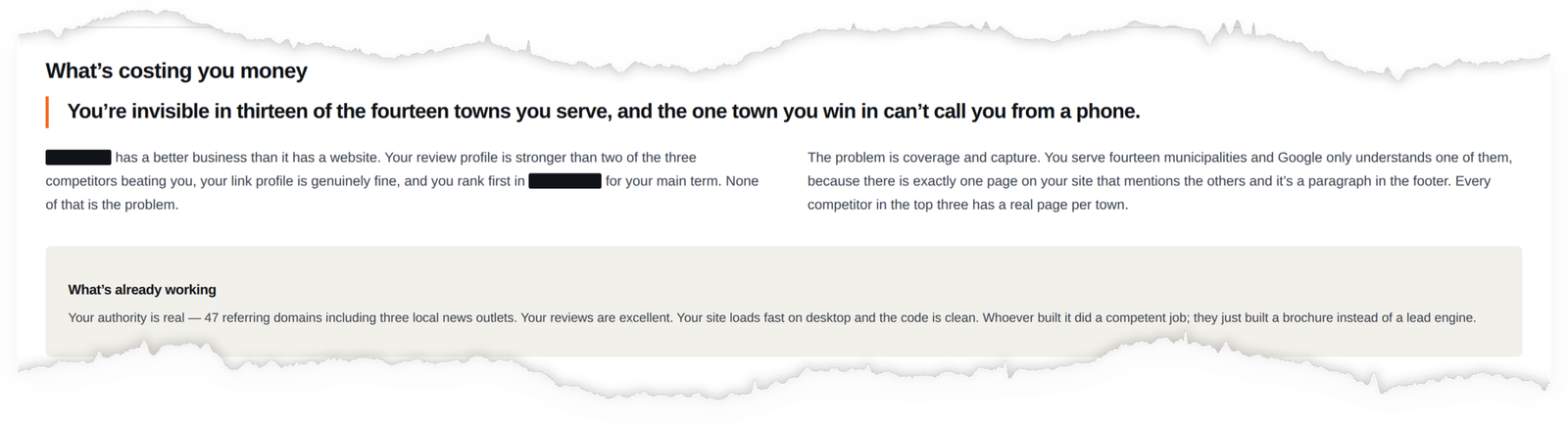
The summary page of a Revenue Audit: one sentence naming the main problem, a short explanation, and a panel headed “what’s already working”. The client name is blacked out.
Page one — what’s costing you moneyOne sentence for what’s costing you money, then what’s already working. The second part isn’t politeness. If I don’t say out loud what’s good, you’ll assume everything I didn’t mention is broken and start fixing things that were fine.
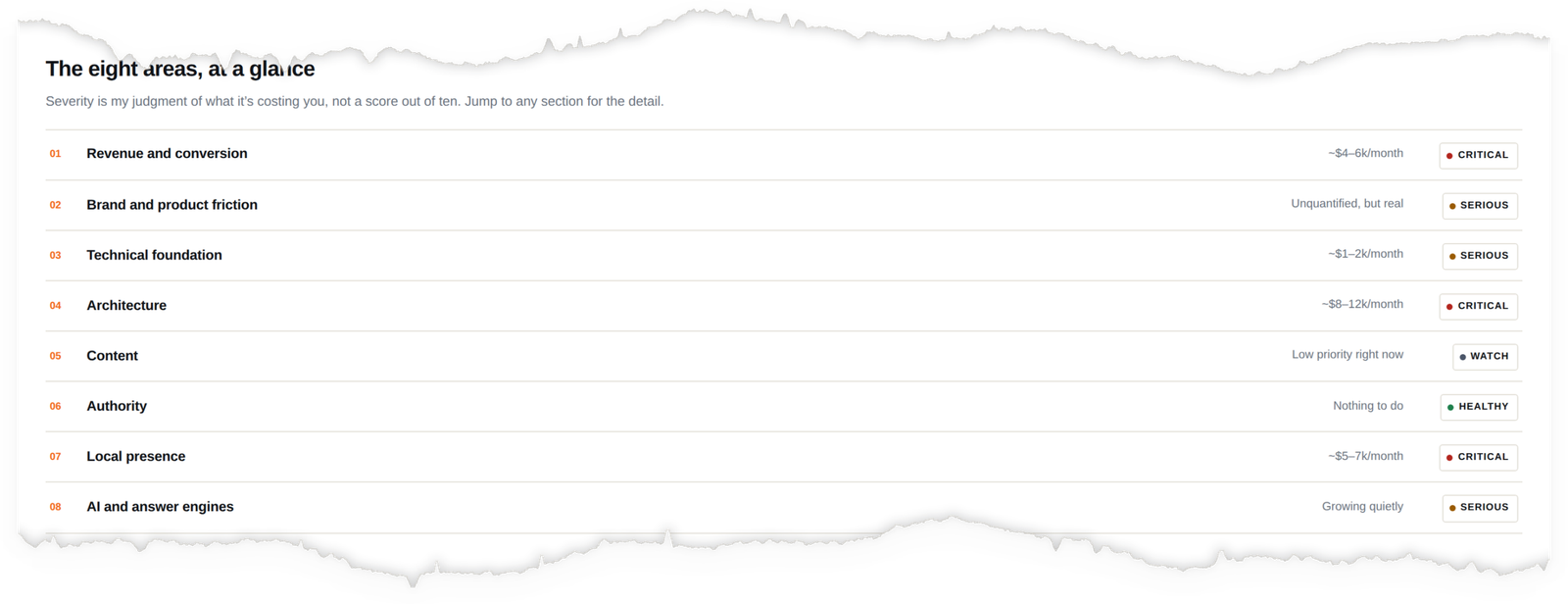
A scorecard listing eight areas of the audit, each with a severity label and an estimated monthly cost.
The eight areas, at a glanceAll eight areas with my judgment of what each one is costing you. Not a score out of a hundred. A dollar range where I can defend one, and “unquantified but real” where I can’t — which is an answer, not a dodge.
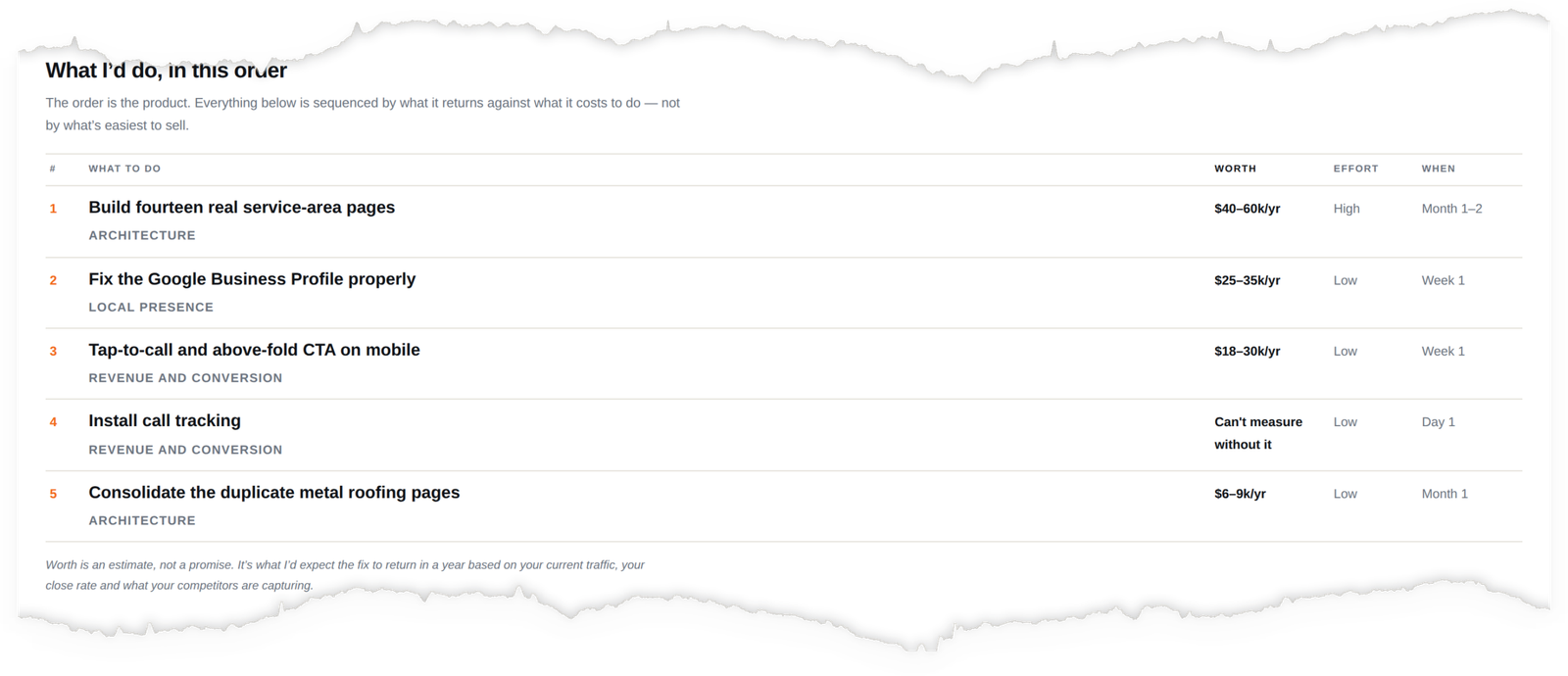
A priority table of five fixes, each with what it is worth per year, the effort required, and when it should happen.
What I’d do, in this orderThe order is the product. Everything here is sequenced by what it returns against what it costs to do — not by what’s easiest to sell you. Two of the top five are things you can hand to your own developer.
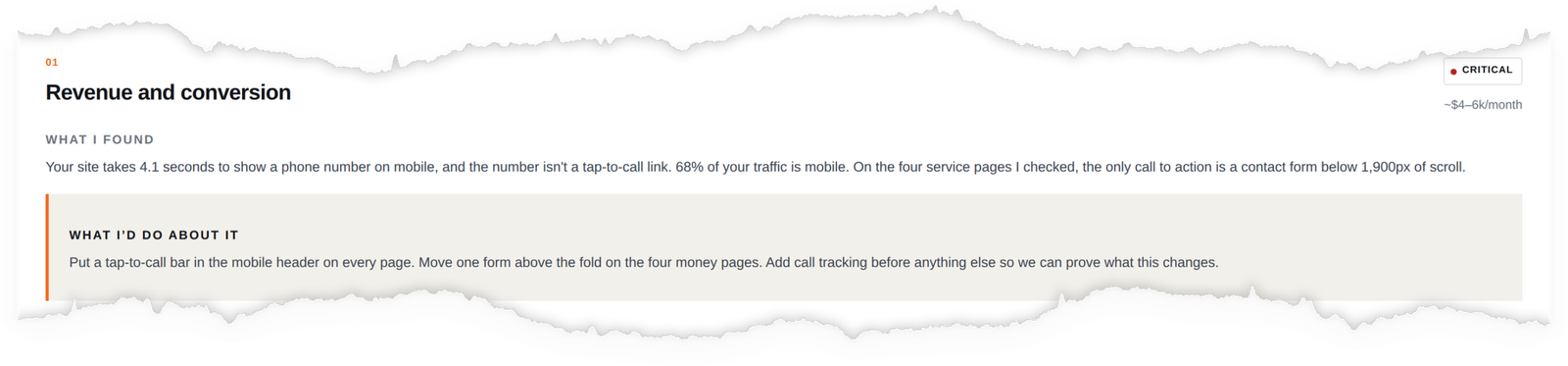
One audit finding marked Critical, with a section headed what I found and a panel headed what I would do about it.
A Critical finding, in fullEvery finding has the same two parts and no more: what I found, and what I’d do about it. Two paragraphs, not twenty. If a finding needs a page of preamble to justify itself, it isn’t a finding.
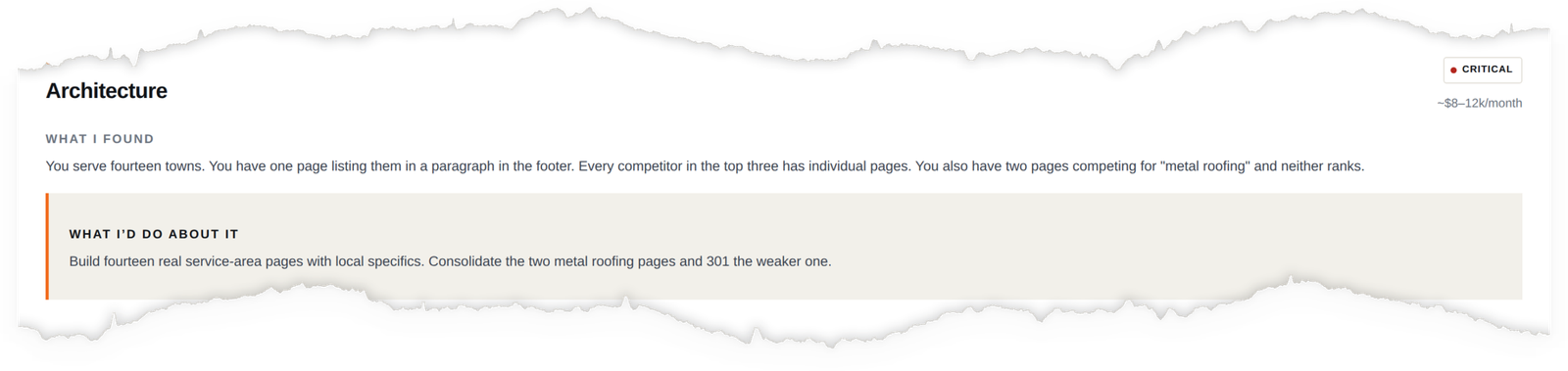
An audit finding about site architecture, marked Critical, with an estimated monthly cost.
The expensive oneThis is the one that takes real work and real money, and it’s the part where thirty years is actually worth paying for. I say that plainly rather than spreading the difficulty evenly across everything so the invoice looks smoother.
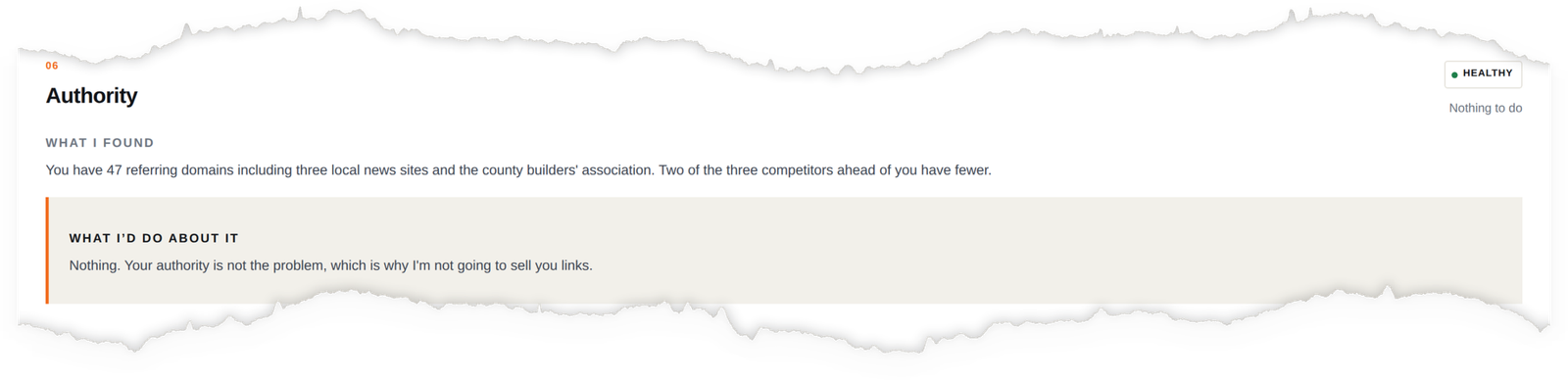
An audit finding about authority and links, marked Healthy, recommending no action.
A finding marked HEALTHYThis is me declining to sell you links, in writing, inside the document you paid for. Your backlink profile is fine. Anybody quoting you for link building against this site is quoting you for work that doesn’t need doing.
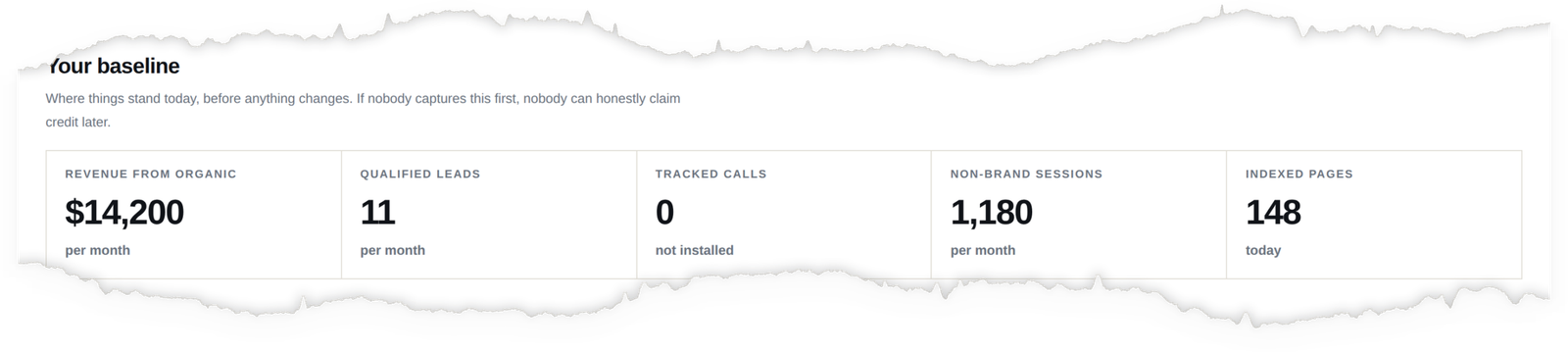
A baseline panel recording the starting metrics before any work begins.
Month zeroEvery number I’ll report against for the rest of the engagement, recorded before I touch anything. Written down at the start, it’s a baseline. Written down at the end, it’s whatever makes the report look best.
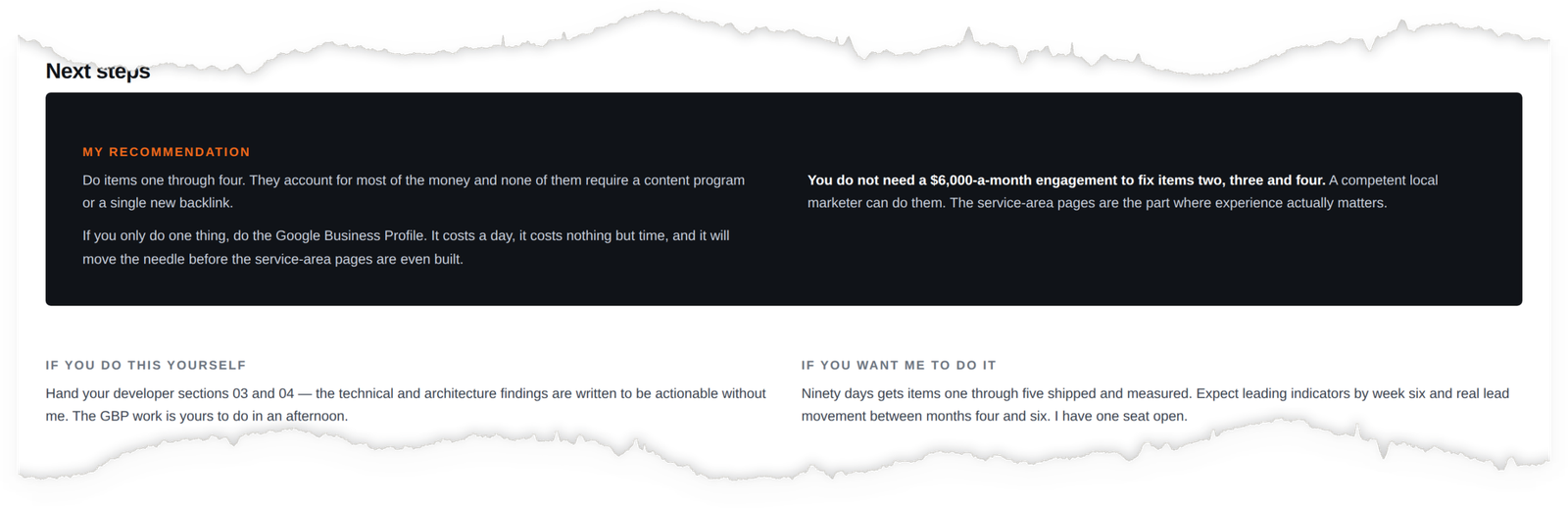
The closing section: a recommendation panel, then two columns headed if you do this yourself and if you want me to do it.
Next steps, both of themMy recommendation, then two honest paths. One of them is you doing most of it without me. The audit is yours either way — that’s not generosity, it’s the only way the thing is worth what I charge for it.
Just as important

Four things you won’t find in it.

A ranking report

You can pull one yourself in ninety seconds. Where you rank is an input to the diagnosis, not the diagnosis.

A keyword list

Two thousand rows sorted by volume is a spreadsheet, not a recommendation. The terms that matter appear inside the findings that need them.

A site health score

A weighted average of checks chosen by a product manager, presented as a grade. Neither an outcome nor a cause.

A proposal

The audit ends with what I’d do, in what order, and what it’s worth. What that costs is a separate conversation you’re free not to have.

Want one pointed at your site?

Two weeks. $3,500. Yours whatever you decide to do next — including taking it to somebody else.