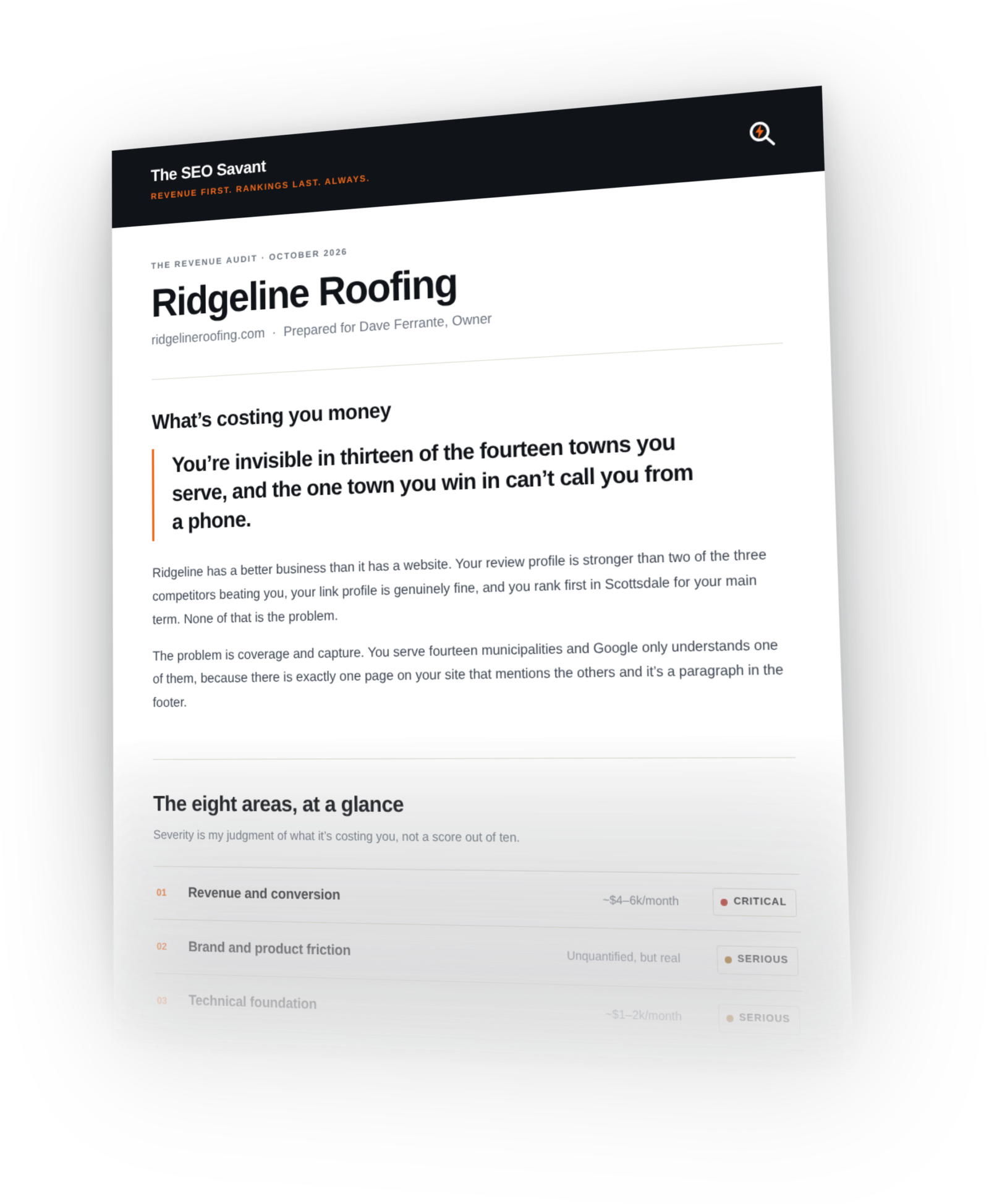
The $3,500 answer to a question you've been guessing at.

Two weeks. Thirty years of pattern recognition. One document that tells you what’s costing you money — and it’s yours regardless of what you do next.

Revenue Audit
What's in it

Eight things I look at.
Most audits cover three.

Then the priority list — all of it, resequenced into what to do first, second, third, with my estimate of what each one is worth. And your baseline, captured before anything changes, so there’s something to measure against later.

Revenue and conversion

Rankings are vanity. Conversions are sanity. The traffic you already have that isn’t turning into anything is the fastest money on the table.

Brand and product friction

Is your offer too complicated to say in a sentence? Is the product itself the reason people leave? No SEO asks this. Thirty years in marketing says it’s often the answer.

Technical foundation

Whether Google can crawl, render and index what you’ve got. Where it’s giving up. What it’s ignoring, and why.

Architecture

How your site is organized versus how it should be. Where your own pages compete against each other for the same terms without you knowing.

Content

What you have, what’s working, what’s dead weight, and the gaps where demand exists and you have nothing to show for it.

Authority

Your link profile against the people beating you. Whether the gap is real, or whether you’re closer than you think.

Local presence

Google Business Profile, map pack position, citations, service-area coverage. For a lot of businesses this is where the money actually is.

AI and answer engines

Whether you show up when someone asks a model instead of a search box, and what’s stopping you if you don’t.

Then: the priority list. All of it, resequenced into what to do first, second, third — with my estimate of what each one is worth.

And your baseline. A month-zero snapshot of traffic, conversions, rankings and revenue. If nobody captures this before work starts, nobody can ever prove anything changed. Almost no agency does it, which is convenient for them.

02-Audit scorecard
Afterwards

What happens next.

We spend an hour on a call and I walk you through it. You ask questions. I answer them — including the ones about whether you should be spending money on this at all.

Then one of three things happens.

You do it yourself.

The document is specific enough to hand to a developer or an in-house marketer. It’s written to survive being used that way. I’d rather that than sell you something you don’t need.

You take it elsewhere.

Fine. You’ll be a dramatically better client for whoever you hire, because you’ll know what to ask for and what to refuse.

You hire me.

Half the fee comes off your first month and I start on item one — if a seat is open. I work with three companies at a time.

Read this before you buy

Some businesses shouldn't buy this.

If you’re brand new with eleven pages and no traffic, you don’t need a diagnosis — you need content and time, and I’ll tell you that rather than take your money.

The audit earns its price when there’s something to diagnose. You have traffic that isn’t converting. Rankings that slipped and nobody can say why. Or you’ve been paying someone for a year and can’t tell what changed.

Send me the URL. I’ll spend two minutes on it and tell you which one you are before you pay me anything. That’s not an audit and I won’t pretend it is — it’s a yes or a no.

Straight answers

Questions about the audit.

Because theirs is generated and mine is written. Two weeks of my time, at thirty years of experience, priced at what that’s worth. If the number feels high, that’s the filter working — this isn’t built for businesses where $3,500 is the decision of the quarter.

Then it says that. It’s happened and it’ll happen again. You’d have paid $3,500 to avoid spending $72,000 on a retainer you didn’t need, which is the best return in this entire price list.

No — and the fact that you know which part you need would surprise me. That’s the whole premise. Splitting the audit means asking you to diagnose yourself in order to buy a diagnosis. Bounce rate feeds rankings; thin conversion looks like a traffic problem and usually isn’t. You get all of it or none of it.

Two weeks from the day I get analytics access. Not from the day you pay — from the day I can see your data. Access delays are the only thing that moves that date.

Stop guessing. Get the answer.

Two weeks. $3,500. Yours to keep whatever you decide to do next.