Field notes · Teardowns
A landscaping company that ranks for its own name and nothing else
The monthly report showed 3,100 organic sessions and a top position for every term that ranks. Nearly all of it was people typing the company’s name. The profitable half of the business was invisible to anyone who didn’t already know it existed.
By Yishai — thirty years in search
What the owner thought was wrong
A landscaping company in the Southeast, 34 employees, about $4.8 million in revenue, roughly split between residential maintenance and design-build commercial work. The owner didn’t think anything was wrong. That’s why this teardown is worth publishing.
He called me because he wanted to grow the commercial side and wondered if there was “anything left to squeeze out of SEO.” His marketing person showed me the monthly report with visible pride. Position 1 for eleven of twelve tracked keywords. Organic sessions up 8 percent year over year. 3,100 a month. Bounce rate low, time on page healthy.
Everything on that report was true and the report was worthless.
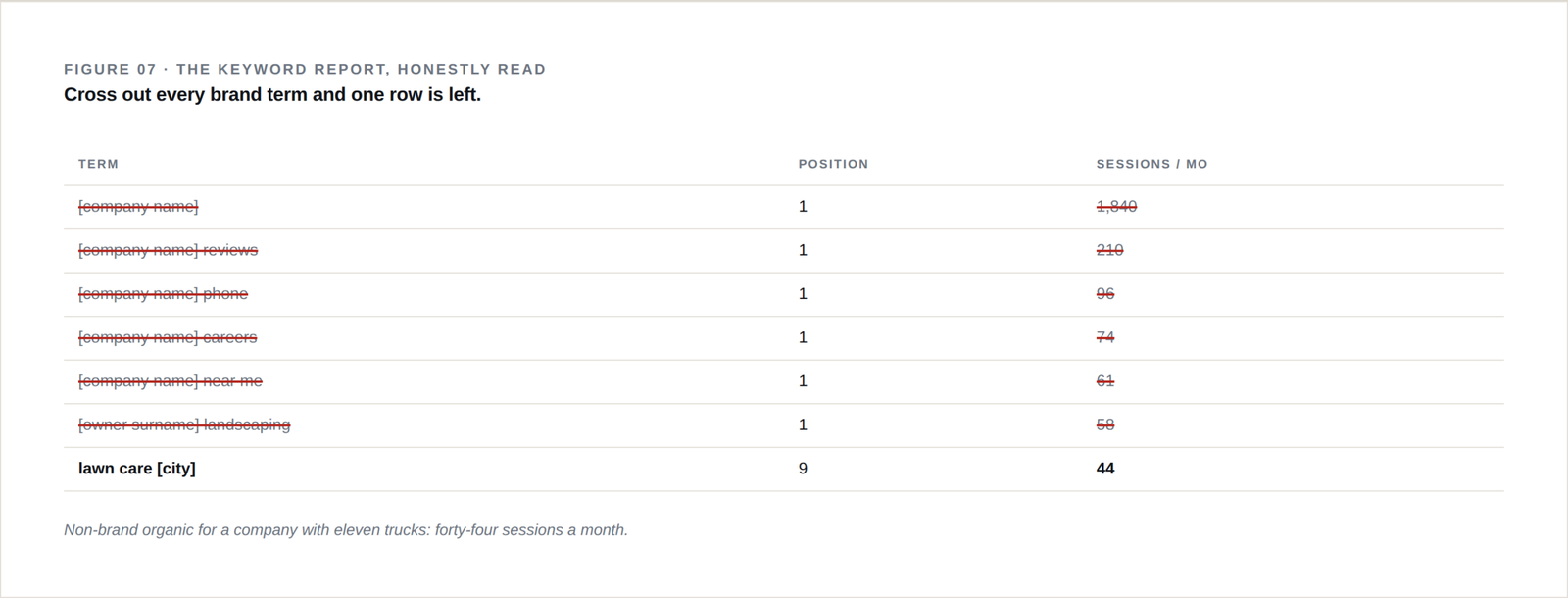
I pulled the query data before the call. Of 3,100 monthly organic sessions, roughly 2,780 came from queries containing the company name or a misspelling of it. Another 190 were the owner’s own name, which is a variation of the same thing. That left about 130 sessions a month, or four a day, from people who did not already know this company existed.
Eleven of the twelve tracked keywords were brand terms. Ranking first for your own name is not an achievement. It’s the default state of the universe. If you don’t rank first for your own name, something is actively broken.
What was actually wrong
The site had no service pages. Not thin ones. None.
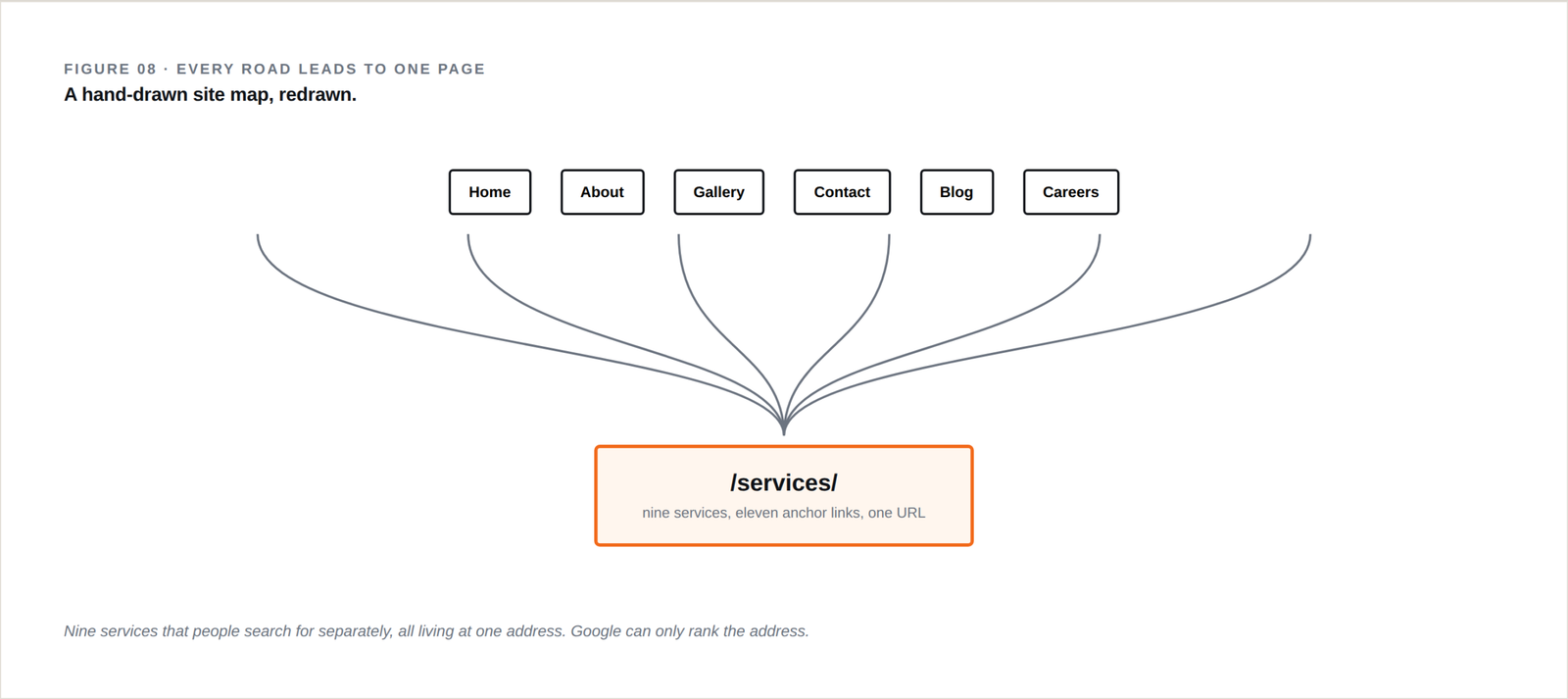
Everything the company did lived on a single page at /services, structured as a stack of anchor-linked sections. Lawn maintenance, irrigation, hardscaping, tree work, landscape design, commercial grounds management, seasonal color, drainage. Eight distinct businesses with eight distinct buyers and eight distinct price points, all sharing one URL, one title tag, one H1, and about 900 words total.
That page was trying to rank for eight things and ranked for none of them, which is exactly what should happen. A URL is the unit of ranking. You get roughly one job per URL. Ask a page to do eight jobs and it will do zero of them.
The anchor links made it worse in a specific way. The internal navigation pointed at /services#irrigation and /services#drainage, which look like distinct destinations to a human reading a menu and are the same document to a crawler. The site’s internal link graph had every path collapsing into one node. There was nowhere to go.
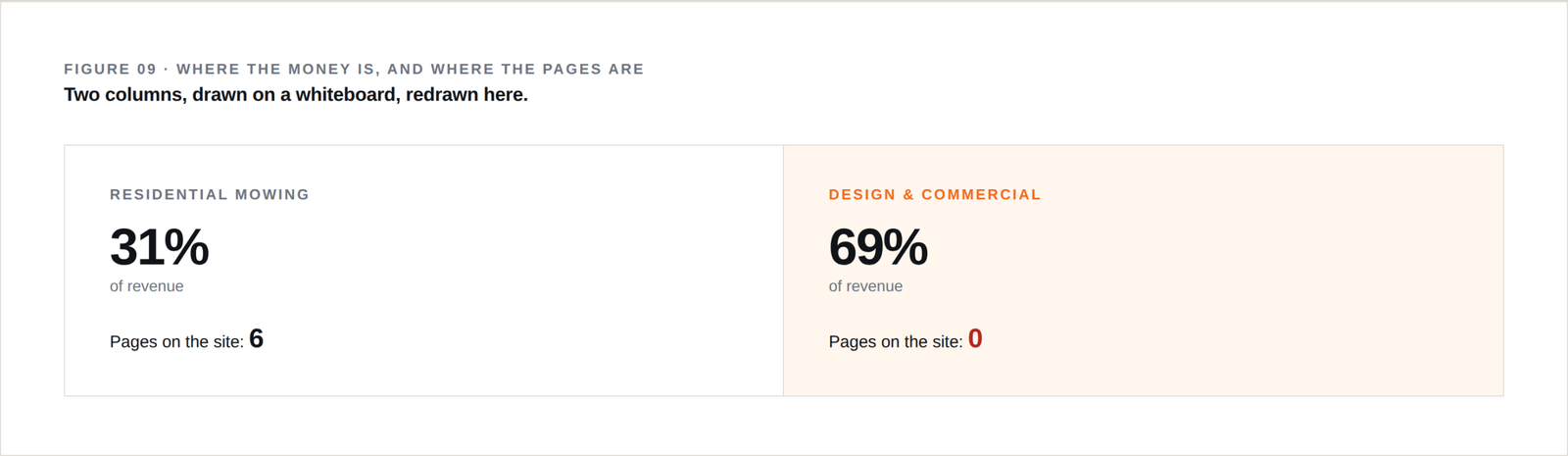
The second problem was worse in dollars. The design-build and commercial division was roughly 45 percent of revenue and closer to 65 percent of profit, because maintenance contracts are a volume business with thin margins and a design-build project on a corporate campus is not. That division had one paragraph on the site. One. On the shared services page, under the heading “Commercial,” ninety-one words long, ending with “contact us to learn more.”
They had completed a courtyard renovation for a regional hospital, a full grounds redesign for a 200-unit apartment community, and streetscape work for a downtown business district. None of it appeared anywhere on the website. The photos were on the project manager’s phone.
Meanwhile the search demand was sitting right there. Commercial landscape maintenance, commercial grounds management, landscape design build, and the metro-qualified versions of each, adding to something like 2,400 monthly searches in their service area. Their competitors ranking for those terms were not better companies. They were companies with pages.
What they were doing right
Their local presence was excellent and I want to be precise about why, because this is the part most companies get wrong and they got right by accident of being run by a serious person.
Their business profile was complete, with service areas defined properly rather than a fifty-mile radius blob, hours accurate including the seasonal change, and 140-odd reviews averaging 4.9. More usefully, the review text was full of the exact language buyers use. People wrote about drainage problems, about a French drain, about regrading a yard that flooded. That’s a keyword research document they were sitting on.
Their site was also fast, accessible, and cleanly built. Real headings, real alt text, no layout shift, keyboard navigable. Whoever built it knew what they were doing on the technical side. The problem was architectural, not technical, and those are different disciplines that get confused constantly.
I told him his site was well built and badly organized, and that those are separate bills.
What I'd do first, second, third
First: break the services page into eight pages, and do the commercial ones first. Real URLs. One service, one page, one job. Each with the service explained the way he explains it on a sales call, what it costs in ranges, what the process looks like week by week, who it’s for and who it isn’t.
The commercial pages come first because that’s where the profit is and the competition is thinner. Residential landscaping search results are crowded with directories and national aggregators. Commercial grounds management results are mostly companies that also have one paragraph. That’s an open door.
Second: get the project work onto the site. Ten case studies, starting with the hospital courtyard and the apartment community. Before photos, during photos, finished photos, the constraint they solved, the timeline, the square footage. The photos exist. They’re on a phone. This is a Saturday of work for the project manager and an afternoon of writing.
Case studies do two things at once. They rank for the specific phrases nobody else targets, and they close commercial buyers, who do not hire on price alone and who want to see that you’ve done a job their size before.
Third: build service-plus-location pages, but only where he actually works and only where there’s a real difference in what he does there. Four cities, not fourteen. I’d rather have four pages that could only have been written about those four places than fourteen that could be swapped with a find-and-replace. I’ve torn down enough of the second kind to know exactly how they perform.
Ranking first for your own name is not an achievement, it’s the default state of the universe.
What I declined to sell them
He asked about a blog. Two posts a month, seasonal lawn care tips, that sort of thing. Every landscaping company has one and most of them are abandoned by the fourteenth post.
I said no. Not “not yet.” No. Seasonal lawn tips compete with extension services and national home improvement sites and they attract people who want to do the work themselves, which is the exact opposite of his buyer. He wants the person who has decided not to do it themselves and has a budget. That person searches for services, not tips.
I also turned down the monthly retainer he offered on the spot. His problem is a build, not a program. Eight service pages and ten case studies is a defined project with an end date, and once it’s done he needs six to nine months of the pages maturing before anyone should be paid to touch them again. I told him to call me next spring. He looked mildly insulted. I’ve had that reaction before and I’ve never regretted it.
What I estimate it's worth
His average commercial contract is $47,000 a year and they retain about five years. His average residential maintenance customer is $2,800 a year. That ratio decides everything about where the effort goes.
Non-brand organic is currently 130 sessions a month. Eight real service pages and ten case studies, in a market where the competition is running the same one-page structure he is, should get him to somewhere between 700 and 1,200 non-brand sessions a month within a year. I’ve seen this pattern enough times to be reasonably confident in the shape, less so in the exact number.
The number that matters isn’t sessions. Commercial buyers convert at low single digits and arrive rarely, but one of them is worth $235,000 over the contract life. If the commercial pages produce two additional signed contracts a year, that’s roughly $470,000 in contracted revenue against a build cost of maybe $22,000 including photography and writing.
Two contracts is not an aggressive target. His close rate on qualified commercial inquiries is 31 percent, which is high, because he’s good at the actual work. He just has no mechanism for a stranger to find out.
That was the finding I wrote at the top of the report. This is a good company that is invisible to everyone who doesn’t already know its name. The fix isn’t clever. It’s eight pages he should have written in 2019.
Want this pointed at your site?
The Revenue Audit tells you what’s actually wrong in two weeks. $3,500, and it’s yours whatever you decide to do next.
