The Revenue Audit · $3,500 · two weeks
The $3,500 answer to a question you’ve been guessing at.
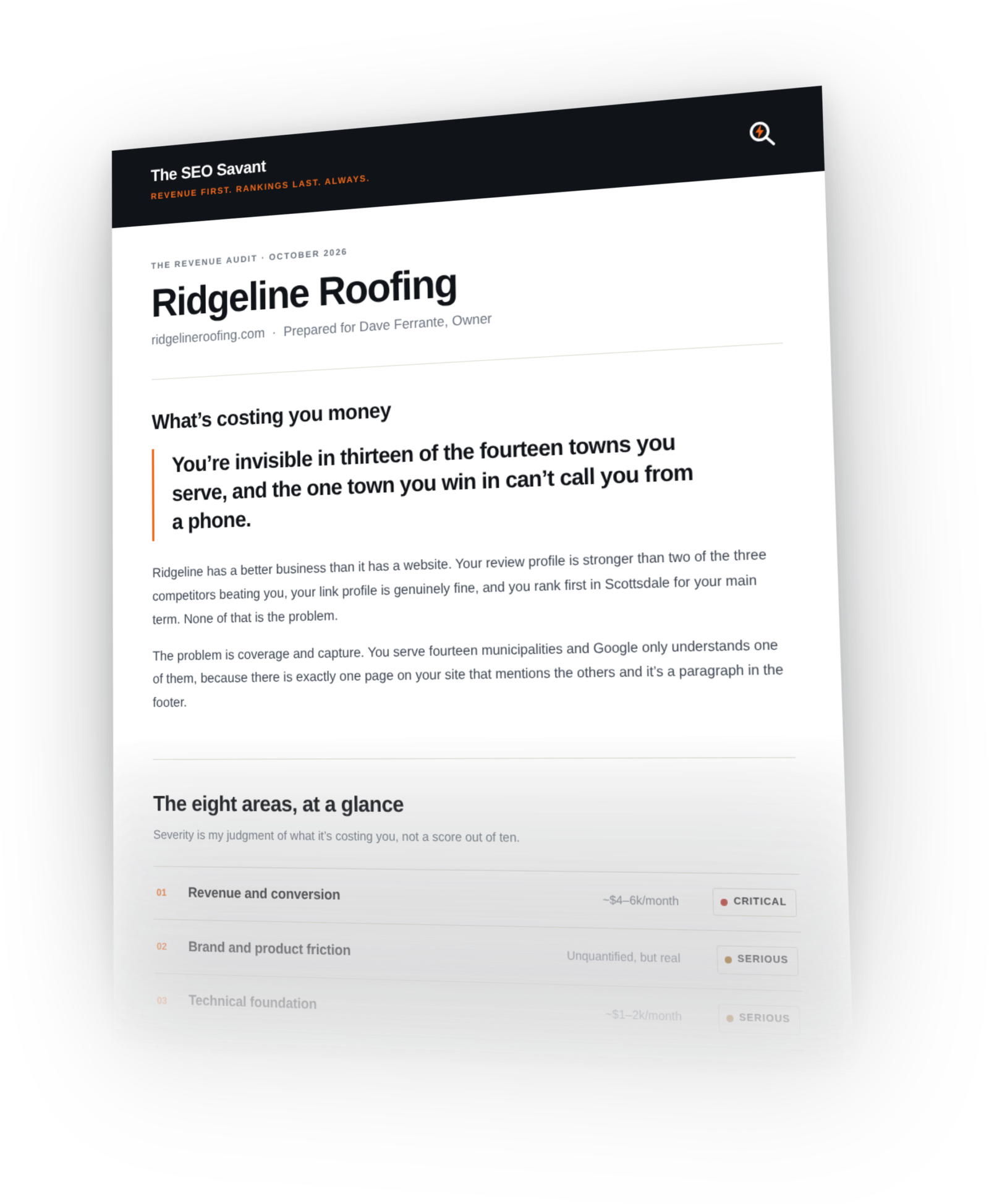
Two weeks. Thirty years of pattern recognition. One document that tells you what’s costing you money — and it’s yours regardless of what you do next.
The clock starts the day I get analytics access, not the day you pay. Half the fee comes off month one of the Engagement if you start inside 60 days.
8
areas examined, not three
2 wks
from analytics access
1 hr
walkthrough call, questions answered
$3,500
fixed. On the page.
What’s in it
Eight things I look at.
Most audits cover three.
Every one gets a finding, a dollar estimate and a place in the priority list. Nothing is a ‘warning’ sorted by colour.
01 · Revenue and conversion
Rankings are vanity. Conversions are sanity.
The traffic you already have that isn’t turning into anything is the fastest money on the table. Numbers you can’t tap, forms nobody finishes on a phone, booking widgets that render blank.
02 · Brand and product friction
Is the offer the problem?
Is your offer too complicated to say in a sentence? Is the product itself the reason people leave? No SEO asks this. Thirty years in marketing says it’s often the answer.
03 · Technical foundation
Can Google even see it?
Whether Google can crawl, render and index what you’ve got. Where it’s giving up. What it’s ignoring, and why.
04 · Architecture
How it’s organised versus how it should be.
Where your own pages compete against each other for the same terms without you knowing. Fourteen towns sharing one paragraph in a footer.
05 · Content
What’s working, what’s dead weight.
What you have, what’s earning, what’s dead weight, and the gaps where demand exists and you have nothing to show for it.
06 · Authority
Your links against the people beating you.
Whether the gap is real, or whether you’re closer than you think. Sometimes it’s a link story. Often it isn’t.
07 · Local presence
Where the money actually is.
Google Business Profile, map pack position, citations, service-area coverage. For a lot of businesses this is most of the game.
08 · AI and answer engines
Who AI recommends instead of you.
Whether you show up when someone asks a model instead of a search box, and what’s stopping you if you don’t.
Inside the Revenue Audit · New
Then I take your three biggest competitors apart.
Every owner asks the same question after the audit: then why are they beating me? Now the audit answers it — side by side, with their numbers next to yours, one competitor and one gap at a time.
Side by side · sample client
| You | A | B | C | |
|---|---|---|---|---|
| Google reviews | 41 | 612 | 284 | 159 |
| Searches they rank for | 212 | 1,840 | 960 | 530 |
| Est. Google Ads / mo | $0 | $14,800 | $5,200 | $0 |
| Sites linking to them | 38 | 412 | 188 | 96 |
| Town pages | 0 | 10 | 6 | 2 |
| Named by AI assistants | 1 | 11 | 6 | 0 |
Estimated Google Ads spend · last 12 months
CriticalCompetitor A has 612 Google reviews. You have 41.
CriticalCompetitor A has 10 pages built for individual towns. You have 0.
SeriousThe AI assistants named Competitor A 11 times. They named you once.
Who they actually are.
Picked from who ranks for your trade in your town today, who sits beside you in the map pack, and who ChatGPT, Claude, Perplexity and Gemini name instead of you. Or you tell me — the one you lose bids to wins.
The searches they get and you don’t.
Every one of them, the ones two or three of them share first. That list is proven demand in your trade, already in the order to build it.
What they spend on Google Ads.
A year of it, month by month, and the ads themselves, word for word — so you can see who just started spending and what they’re promising.
Who links to them and skips you.
The chamber, the suppliers, the associations and the local press that already cover your trade. Most of them are a phone call, not a campaign.
How their sites are built.
Town pages, service pages and articles, counted from their own sitemaps. It’s usually the answer to “how are they everywhere?”
Why each one is ahead.
One finding per gap, with their number and yours in the same sentence. Then it goes on your priority list with everything else, in the order I’d fix it.
What I won’t do: call a competitor’s traffic your lost revenue. Ad-spend figures come from a panel that samples Google, and I tell you where it under-counts — ads aimed at one town, Local Services Ads. The dollar figure in your audit stays the one you can defend.
Then
The priority list.
Then your baseline.
Then: the priority list. All of it, resequenced into what to do first, second, third — with my estimate of what each one is worth.
And your baseline. A month-zero snapshot of traffic, conversions, rankings and revenue. If nobody captures this before work starts, nobody can ever prove anything changed. Almost no agency does it, which is convenient for them.
- Priority listEvery item, in order, with what it’s worth.
- BaselineMonth zero, captured before anything changes.
- Two healthy findingsThe things I tell you not to touch.

Some businesses shouldn’t buy this.
If you’re brand new with eleven pages and no traffic, you don’t need a diagnosis — you need content and time, and I’ll tell you that rather than take your money.
The audit earns its price when there’s something to diagnose. You have traffic that isn’t converting. Rankings that slipped and nobody can say why. Or you’ve been paying someone for a year and can’t tell what changed.
Send me the URL. I’ll spend two minutes on it and tell you which one you are before you pay me anything. That’s not an audit and I won’t pretend it is — it’s a yes or a no.
Afterwards
What happens next.
We spend an hour on a call and I walk you through it. You ask questions. I answer them — including the ones about whether you should be spending money on this at all. Then one of three things happens.
01
You do it yourself.
The document is specific enough to hand to a developer or an in-house marketer. It’s written to survive being used that way. I’d rather that than sell you something you don’t need.
02
You take it elsewhere.
Fine. You’ll be a dramatically better client for whoever you hire, because you’ll know what to ask for and what to refuse.
03
You hire me.
Half the fee comes off your first month and I start on item one — if a seat is open. I work with three companies at a time.
Straight answers
Questions about the audit.
“Why $3,500 when others charge $500?”
Because theirs is generated and mine is written. Two weeks of my time, at thirty years of experience, priced at what that’s worth. If the number feels high, that’s the filter working — this isn’t built for businesses where $3,500 is the decision of the quarter.
“What if the audit says I don’t need you?”
Then it says that. It’s happened and it’ll happen again. You’d have paid $3,500 to avoid spending $72,000 on a retainer you didn’t need, which is the best return in this entire price list.
“Can I just get the SEO part? I don’t need the conversion stuff.”
No — and the fact that you know which part you need would surprise me. That’s the whole premise. Splitting the audit means asking you to diagnose yourself in order to buy a diagnosis. Bounce rate feeds rankings; thin conversion looks like a traffic problem and usually isn’t. You get all of it or none of it.
“Do you sign NDAs?”
Yes.
“How long, really?”
Two weeks from the day I get analytics access. Not from the day you pay — from the day I can see your data. Access delays are the only thing that moves that date.
Something else? Email hello@theseosavant.com. I answer within one business day.
Stop guessing. Get the answer.
Two weeks. $3,500. Yours to keep whatever you decide to do next.