Field notes · Teardowns
A law firm ranked #1 and lost the case anyway
A six-attorney plaintiff-side firm in a Midwestern county seat, around $9M in annual fee revenue, holds the top organic position for the term that matters most in its market. It also takes a median of 19 hours to answer an inquiry. The rankings are real. Everything downstream of them is theater.
By Yishai — thirty years in search
What the managing partner thinks is wrong
He thinks he needs more traffic. He came to me with a competitor’s backlink report and a question about whether he should be publishing twice a week instead of twice a month.
His firm ranks first for the highest-value term in his county. Eleven of fourteen tracked terms sit in the top three. The map pack listing is first for four of the five city-modified variants. Organic sessions run about 4,900 a month, which for a county seat of 94,000 people is close to the ceiling. There is no meaningful traffic left to win. He is at the front of the line and he keeps asking me how to get further forward.
So I skipped the content conversation entirely and asked to see three things: the last 90 days of form submissions with timestamps, the phone log with timestamps, and the signed-case list. It took his office manager four days to assemble, which was itself a finding.
Sixty-one inquiries in the sample. Nine signed. That’s a 14.8 percent signing rate on inquiries that arrived through the single best organic position in the market. I’ve seen well-run intake on comparable inquiry quality run 28 to 35 percent. Everything I found afterward was an explanation of that gap.
The rankings are real. The intake isn't.
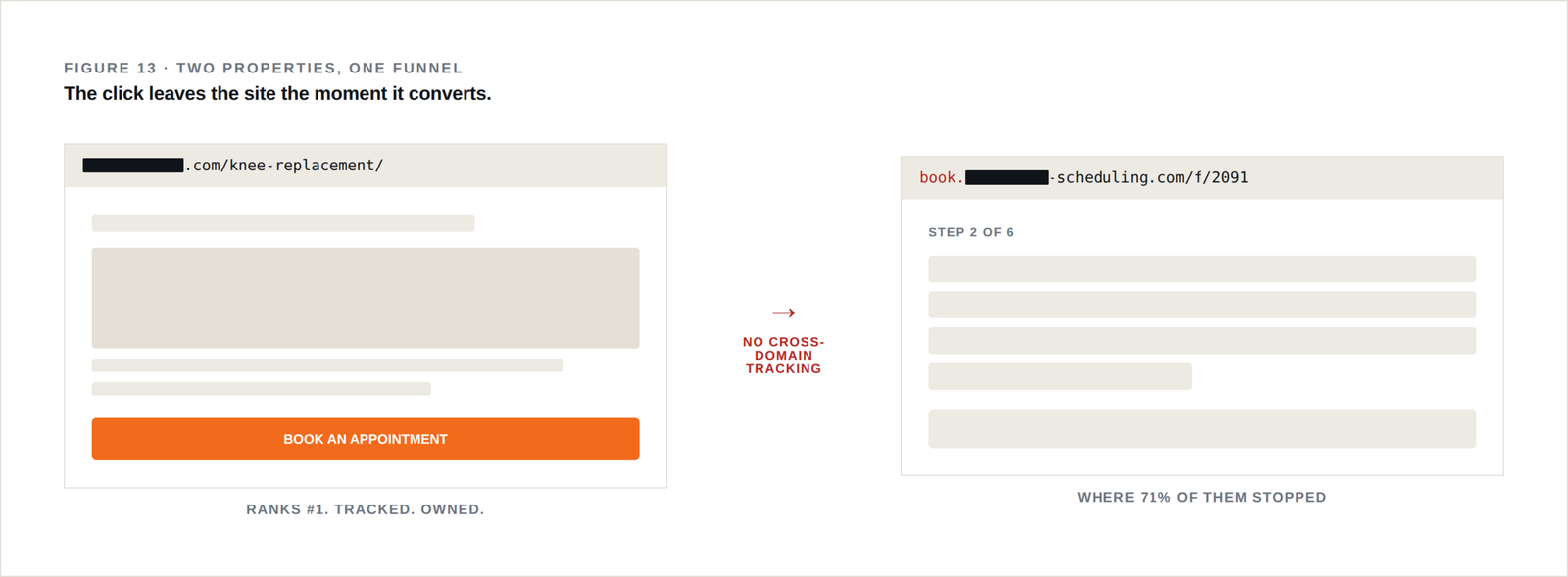
The single largest leak is a subdomain. His “Schedule a Consultation” button, which appears in the header of every page and is the primary conversion action on the site, points to a third-party scheduling tool running on a subdomain of his own domain.
Four things go wrong at once. It loads in 6.2 seconds on mobile over a throttled connection, against 2.4 for the main site. It uses different fonts, a different logo lockup, and a stock blue that appears nowhere in his brand, so it reads as a phishing page to anyone paying attention. It asks for an account before it asks about the accident. And because the vendor strips referrer data and sets its own session, every consultation booked through it lands in his analytics as direct traffic, which is why he believes organic doesn’t convert.
I instrumented the button for a week. Of the people who tapped it, 38 percent never reached a rendered form. They tapped, waited, and left. That’s not a conversion rate problem, it’s a load-time problem wearing a conversion rate costume.
Nobody works Friday night, but everybody crashes then
Forty-four percent of his form submissions arrive between 6 p.m. Friday and 8 a.m. Monday. That’s not unusual for injury work. People get hurt on weekends and they research lawyers from a couch with an ice pack on.
Those submissions go to a shared inbox monitored by an office manager who works Monday through Thursday. Median first response across the whole sample was 19 hours. For submissions that arrived after 5 p.m. on a Friday, median first response was 63 hours. A person who filled out his form at 6:41 on a Friday evening heard back at 9:12 Tuesday morning.
By Tuesday morning that person has already talked to two other firms. Not because those firms rank better, but because those firms picked up.
There’s a second version of the same wound on the phone side. After hours, calls route to a voicemail box whose greeting says the office is closed and gives office hours. No answering service, no overflow number, no text-back. In the 90-day sample there were 34 after-hours voicemails. Eleven were returned. Nineteen of the 34 called a second time, which tells you what they were willing to do before somebody else got them.
A number one ranking is a promise. Intake is whether you keep it.
Attorney bios that are captions, not pages
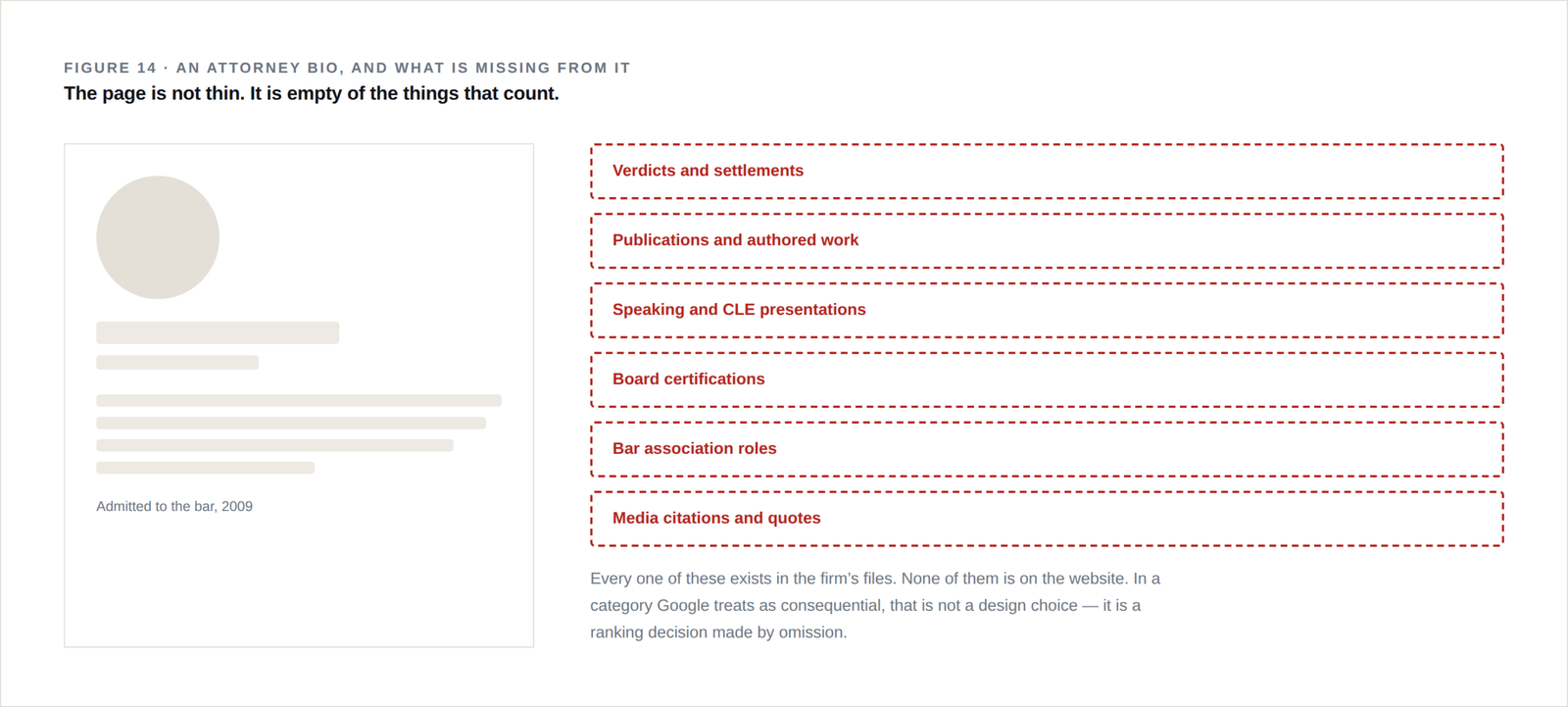
Six attorneys, six bio pages, averaging 118 words each. Each one lists a law school, a bar admission year, and a sentence about enjoying the outdoors. That’s a caption under a headshot, not a page.
What’s missing is everything a person or a machine would use to decide this attorney is the right one. No case results. No named practice areas with matching page links. No county or court where the attorney actually appears. No speaking engagements, no published work, no verdict or settlement history, no professional associations. The bar admissions are inside a JPEG of a certificate with no alt text, so they exist visually and nowhere else. There’s no schema markup identifying these as people connected to the organization, and the practice area pages don’t link to the attorneys who handle them.
This matters more than it did three years ago. Answer engines assembling a response to “best car accident attorney in [county]” are looking for attributable, entity-level evidence about named humans. His site gives them a headshot and a hobby. The firm is the top organic result and simultaneously close to invisible in generated answers, because the two systems want different things and he’s only fed one of them.
Fix looks like this: 700 to 1,100 words per attorney, results with amounts where his bar rules allow it, explicit courts and counties, person schema, and reciprocal links between each practice area page and the attorney who owns it. Six pages. Two weeks of a writer’s time and a compliance read.
Speed to lead, measured for the first time
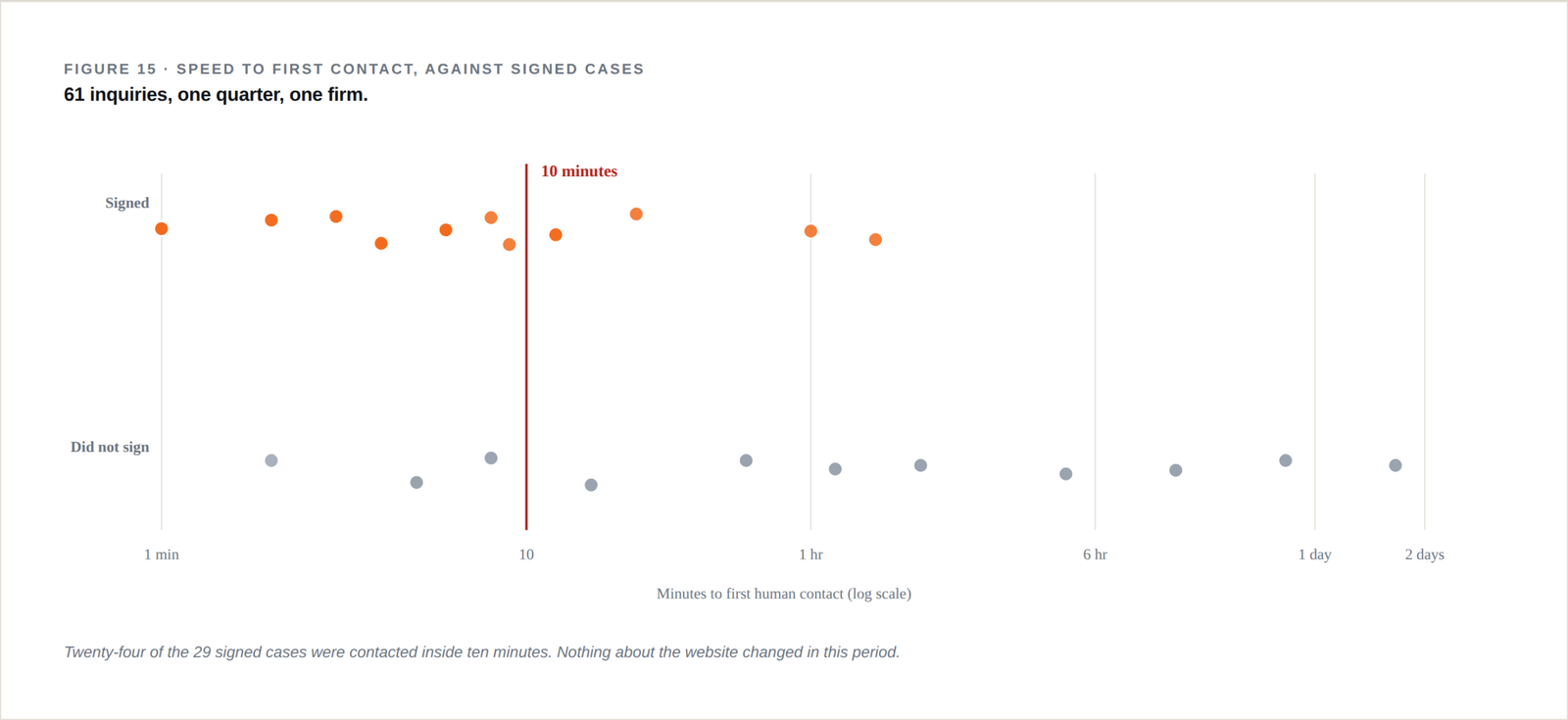
Nobody at the firm had ever measured time from inquiry to first human contact. When I built the column and sorted by it, the shape appeared immediately.
Of the 61 inquiries, the 12 contacted in under 10 minutes signed at 33 percent. The 29 contacted after four hours signed at 6.9 percent. Same source, same market, same intake script. The only variable that moved was elapsed minutes, and it moved the outcome by roughly five times.
That single column is worth more to this firm than any keyword report I could produce. It costs nothing to maintain. It requires one timestamp on receipt, one on first outbound contact, and somebody willing to look at the difference every Monday.
First, second, third, and what it's worth
First, answer the phone. A live answering service with a legal intake script, running nights and weekends, costs $600 to $1,400 a month in his market. Add a text-back autoresponder on missed calls and a real human reply target of 15 minutes on weekend form fills. This is a staffing decision, not a marketing one, and it outranks everything else on this list.
Second, bring scheduling onto the main domain, or at minimum onto a page that carries his brand, loads in under three seconds, asks four questions, and preserves the session so his analytics stop lying to him.
Third, rebuild six bios into six actual pages. That’s the piece that compounds, and it’s the only piece here that touches rankings at all.
The arithmetic. He gets about 71 inquiries a month and signs 9. Moving the signing rate from 14.8 percent to 24 percent, which is below what I’d consider good, puts him at 17. His average realized fee per signed case over the last two years is roughly $12,800. That’s an additional $102,000 in fees per month of intake, with the honest caveat that plaintiff fees land 14 to 22 months out, so this is a 2027 revenue conversation started with a 2026 phone bill.
He asked me to include a content plan in the audit. I took it out. He doesn’t need more content. Writing him a blog calendar would have been the easiest $3,500 I ever earned and it would have made his business worse by giving him somewhere comfortable to put his attention.
Want this pointed at your site?
The Revenue Audit tells you what’s actually wrong in two weeks. $3,500, and it’s yours whatever you decide to do next.
