The third price
The most expensive option isn’t on this page.
There are two prices above, and a third one this page can’t print because it’s different for every business: the price of leaving things as they are. It never arrives as an invoice. It arrives as a phone that rings out at 6:04pm, an ad click that lands on a page that can’t close, an inquiry answered tomorrow that was ready to buy today. Nobody budgets for it because nobody bills for it — which is exactly how it gets to be the biggest line item in the marketing budget without ever appearing in one.
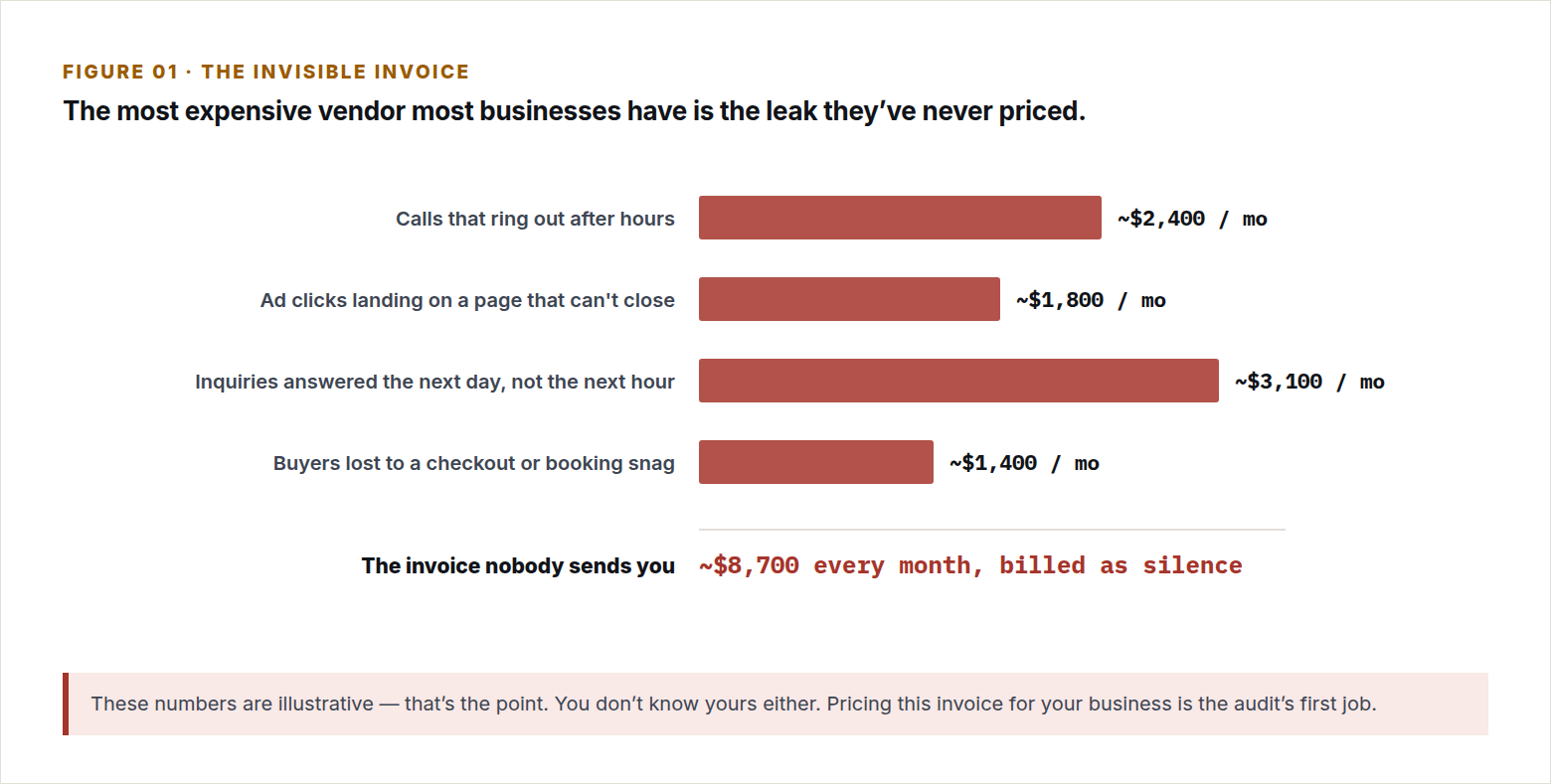
This is why the audit exists, and why it comes first. Before anything gets “optimized,” you deserve to know what doing nothing is actually costing you — in your numbers, not industry averages. Sometimes the honest answer is that your leak is small and you shouldn’t hire me. You’ll get that answer too. It’s a strange sales strategy, but it’s the only one I’ve found that lets me sleep and keeps clients for years instead of quarters.
Same money, three ways
What $3,500 buys here — and everywhere else.
Thirty-five hundred dollars is real money, so spend it like an investor: compare what it buys. In this industry it typically buys one month of rented clicks, or two months of a cheap retainer’s activity reports. Both are spending. The audit is the only version of that money that behaves like buying — you end the two weeks owning something: your baseline, captured before anything changed, and a priority list with a dollar estimate attached to every item on it.
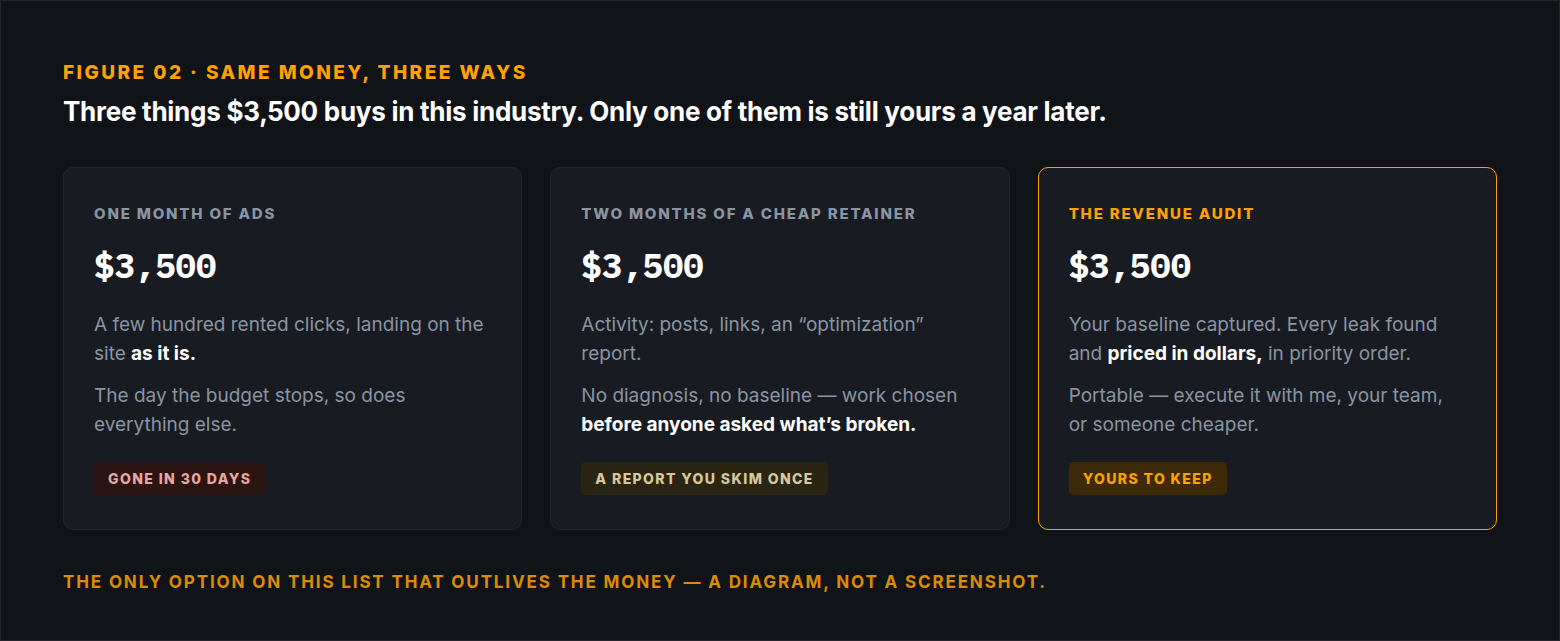
And it’s portable, which is the part that removes your risk. The worst case — the absolute floor — is that you decide not to work with me, hand the audit to your own team or a cheaper executor, and fix the list without me. That’s not a consolation prize; it’s a path I’ll actively help you take, including telling you who’s good. The audit was built to be worth its price even if we never speak again.
The break-even
The audit has to find one thing. It has never found zero.
Strip away everything else and the purchase decision is one question: will two weeks of me looking at your business find at least $3,500 that’s leaking? Look at what the typical findings are worth over a year and you’ll see why I’m comfortable putting the price on the page. These aren’t exotic discoveries. They’re the ordinary, boring failures — response time, call handling, the last page before the money — that almost every site has at least one of.
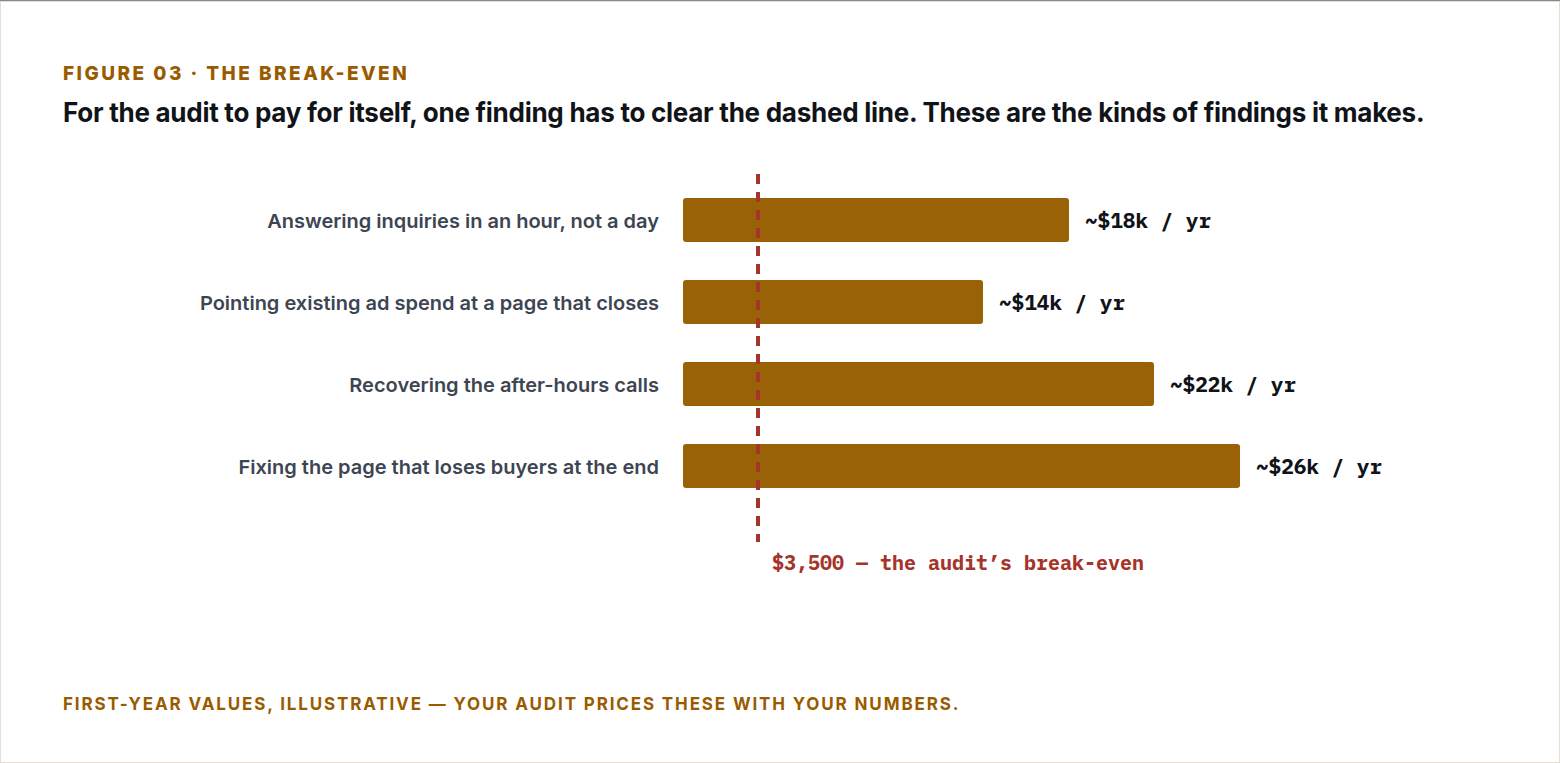
Notice what the deliverable is not: a hundred-page PDF of every technical issue a crawler can list, ranked by nothing. You get the short list, in order, with my estimate of what each item is worth in revenue — because a finding without a dollar figure is just an opinion, and you can’t make a business decision with an opinion. That’s the difference between an audit and the free “audits” your inbox is full of: theirs are sales scripts. Mine is the product.
Who does the work
You’re not hiring an agency. That’s the point.
Six thousand a month at a mid-size agency is a respectable mid-market retainer — and it buys a structure: an account manager to talk to you, a strategist who sees your account a couple of hours a month, and juniors or subcontractors who do the actual work, chosen for cost. None of them did your diagnosis. None of them answers personally for the outcome. The structure isn’t evil; it’s just what it costs to run an agency, and you’re the one paying for it.
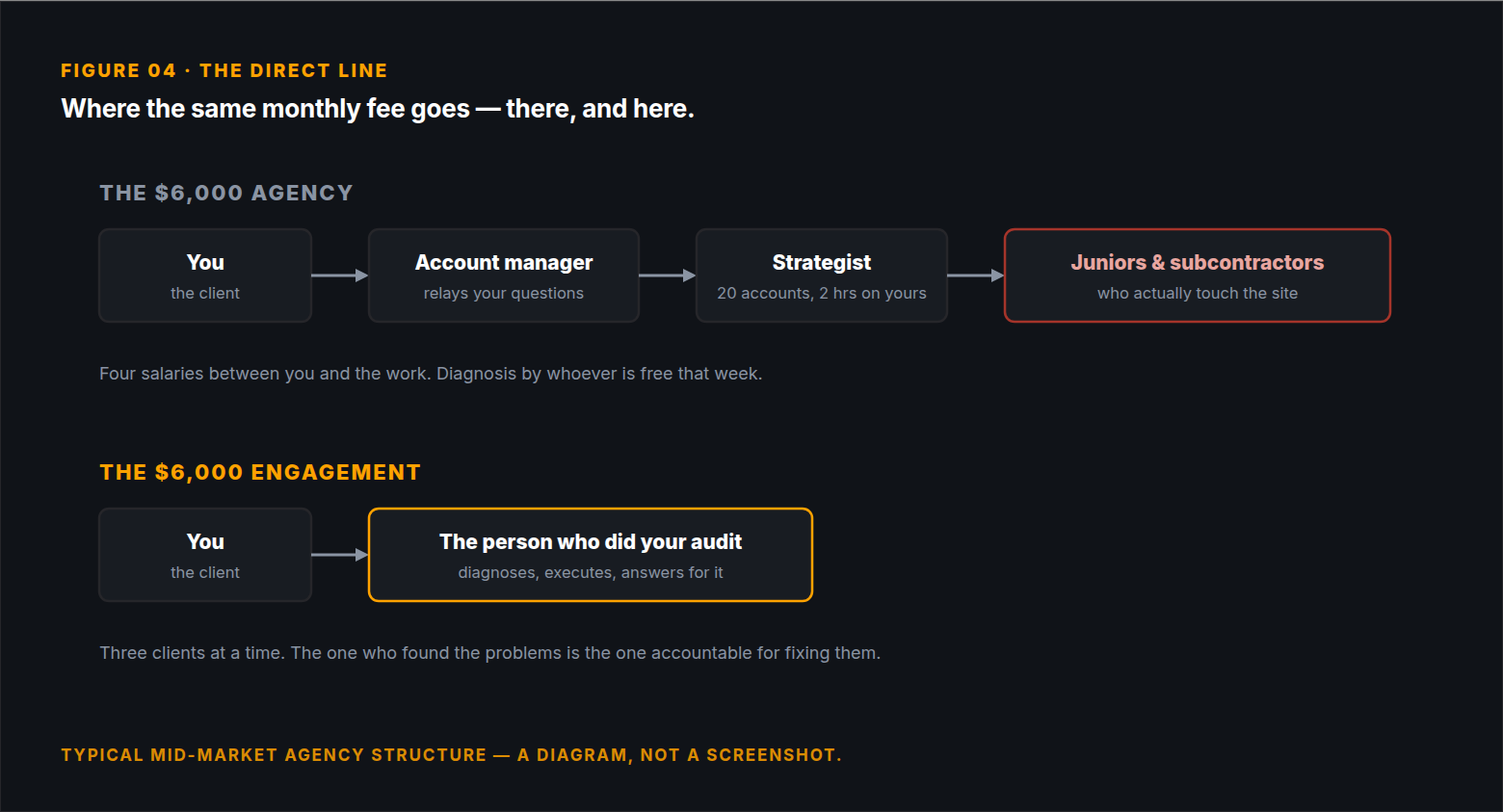
Here the person who found your problems is the person fixing them, and the person fixing them is the person on the monthly call explaining what moved and what didn’t. Thirty years of pattern recognition, three clients, no layers. The honest trade-off: three clients means there’s sometimes a wait for an engagement slot. The Revenue Audit never waits — and it’s where every engagement starts anyway. Book it, and whatever you decide afterward, you’ll know exactly what your website is worth fixing.