
Proof
Judgment, shown
rather than claimed.
Anyone can say they’re experienced. This page is what thirty years actually looks like when it’s pointed at a website — the diagnosis, the number it moved, and the reasoning in between.
Read one yourself
A real Revenue Audit, redacted.
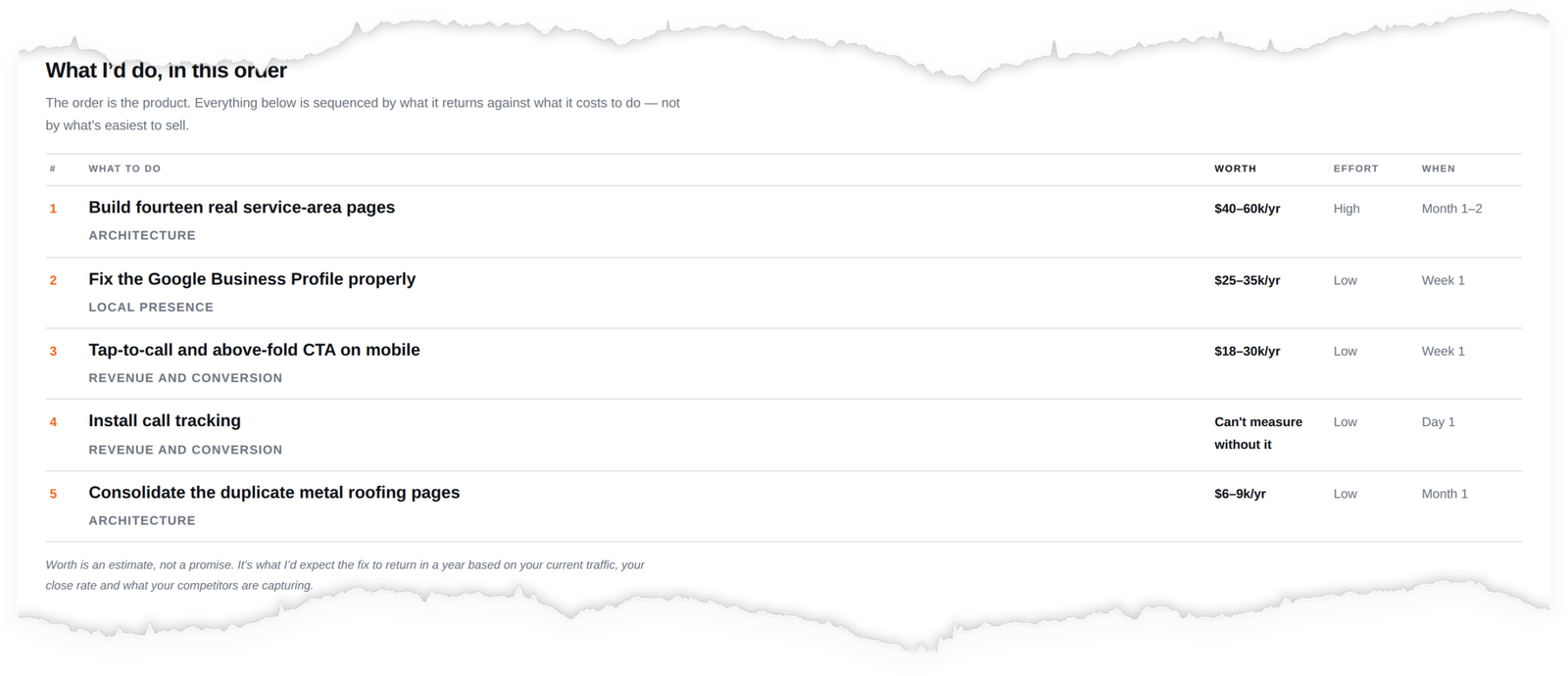
Every name, URL and figure that could identify the client is blacked out. Everything else is exactly as delivered — the summary, the severity scorecard, the priority list with what each item is worth, and the two findings I marked healthy and told them not to touch.
It is the most useful thing on this website. If the thinking in it doesn’t convince you, nothing I could put in a testimonial would.
The work
Six sites, taken apart.
Three were paid engagements, anonymised under NDA — the industry, the market size and every number are real, the name is not. Three were teardowns: public sites I diagnosed for free because nobody asked me to. The second set is the more honest half, because there was no client to please.

Teardown · Home services, six locations
They were optimising for the 30% of conversions that didn’t matter.
Six locations. Every report counted form fills. Ninety percent of their booked jobs started with a phone call nobody was measuring.
Read the note
Teardown · E-commerce, 11,000 products
Google was crawling 340,000 URLs to find 11,000 products.
Faceted navigation had multiplied the catalogue thirty times over. Most of the store had never been indexed at all.
Read the note
Teardown · Multi-market, booking
They ranked first and still couldn’t get anyone booked.
Top three in every market. A booking widget that rendered a blank white box on half the devices that reached it.
Read the note
Paid engagement · anonymised under NDA
$3,000 a month in ads, landing on a page that lost three buyers in four.
The ads were fine. The site behind them was the problem, and nobody in the building could say which half of the budget worked.
Read the note
Paid engagement · anonymised under NDA
Ranked #1 for the term that matters. Nineteen hours to answer an inquiry.
The rankings were real. Everything downstream of them was theatre, and the median response time was doing the losing.
Read the note
Paid engagement · anonymised under NDA
Ranking for its own name, and nothing anybody searches for.
The keyword report looked healthy until you crossed out every brand term. One row was left standing.
Read the note