Skip to content
HVAC

You publish furnace content in October. That’s already too late.

Heating, cooling and indoor air quality. Thirty years in search, and a diagnosis before anyone asks you for a retainer.

Two weeks. Yours to keep whatever you decide to do next — including hiring someone else.

Repair or replace

Teach the $5,000 rule before your competitor does.

The most valuable conversation in HVAC isn’t “who should fix my AC” — it’s “should I fix it at all?” Every homeowner with a twelve-year-old system and an $850 repair quote is quietly doing that math tonight, and they’re doing it on Google, with your competitors’ content, because almost no contractor is willing to publish the honest answer.
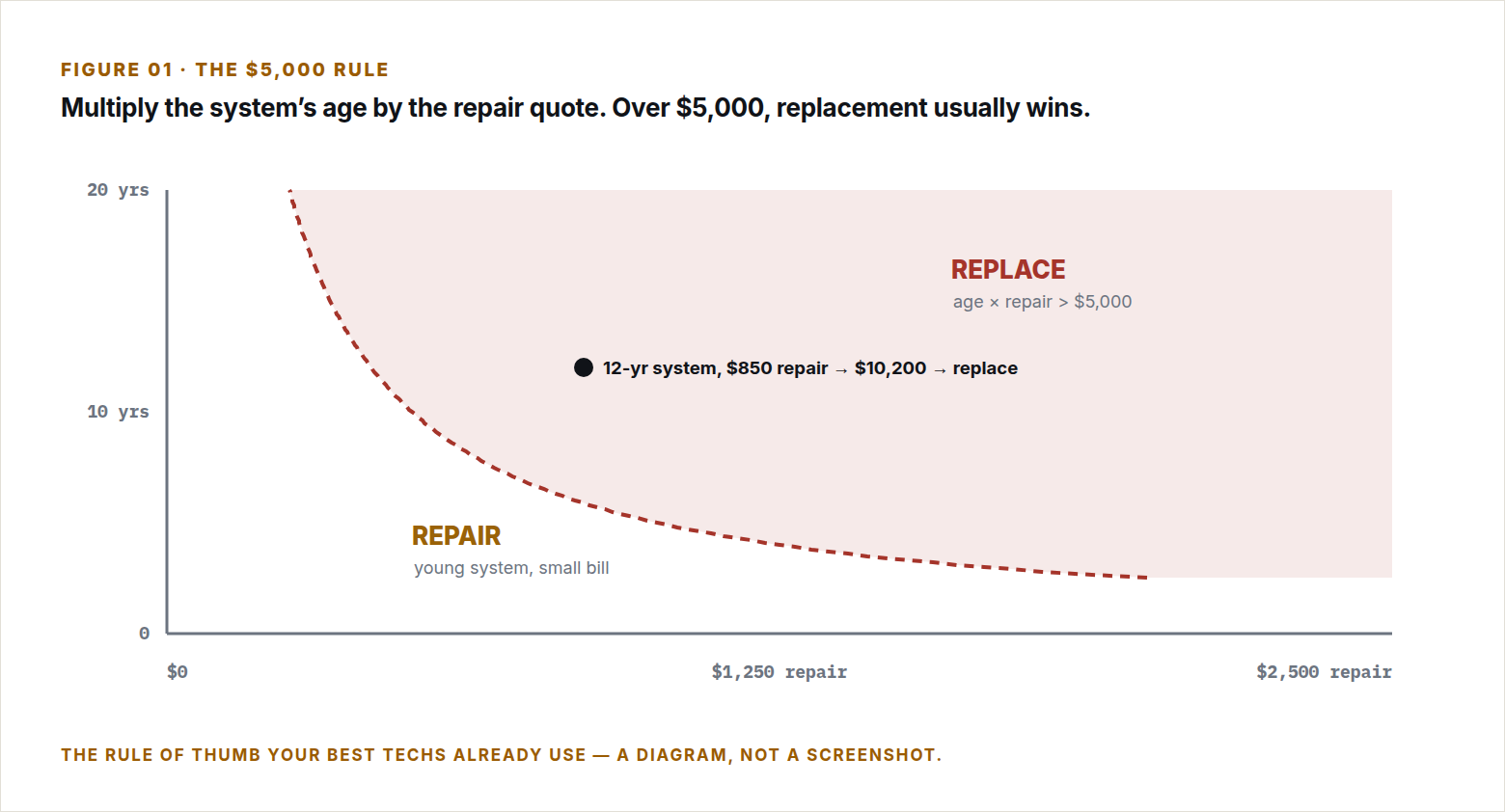
The $5,000 rule
The $5,000 ruleAge times repair cost, against $5,000. Your senior techs already use some version of this at the kitchen table — publishing it just scales the trust.

Here’s why publishing it wins you installs instead of talking yourself out of repairs: the homeowner who reads your honest repair-or-replace page and concludes “repair” was never buying a system this year — but now you’re the company that told the truth, and you’ll do that repair. The one who concludes “replace” just made a five-figure decision on your page, using your framework — and people overwhelmingly buy from the company that helped them decide. Either way, the page earns. That’s what honest content does that brochures can’t.

The decision day

A $9,000 sale, researched and closed in sixteen hours.

Most five-figure purchases get weeks of research. A dead AC in summer gets one day — and that compressed day is the highest-stakes stretch in your entire marketing calendar, because the homeowner runs three different searches before dinner and a different page wins each one.
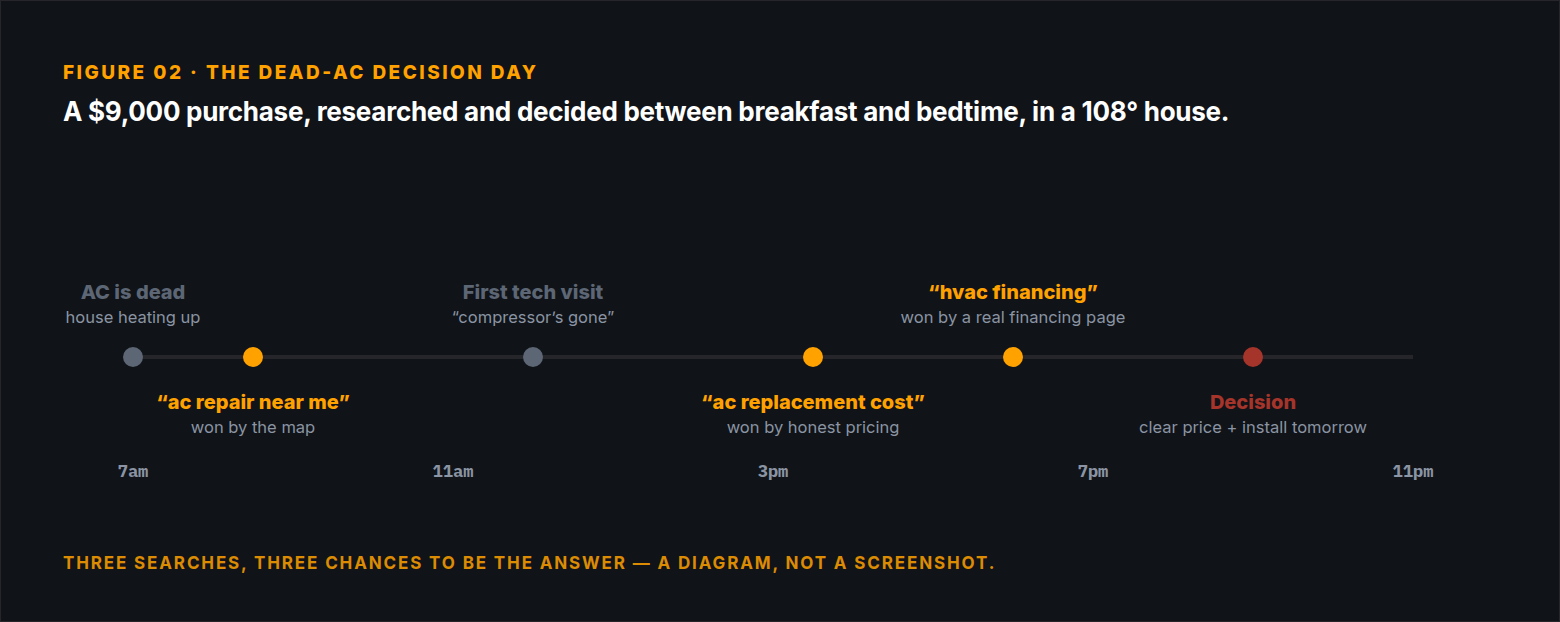
The dead-AC decision day
The dead-AC decision dayMorning: the map decides who diagnoses. Afternoon: honest pricing decides who quotes. Evening: the financing page decides who installs tomorrow.

Notice what closes the sale at 9pm: not the lowest bid — the clearest path. A real price on a real page, financing that could be started from the couch, and a promise of tomorrow. Most HVAC sites in any metro can win the morning search and still lose the install because they have nothing for the afternoon and evening ones: no replacement-cost page, no financing page, no same-day commitment anywhere in writing. Build those two pages and you’re present for the whole day instead of the first hour of it. That’s the difference between selling diagnostics and selling systems.

Reviews that rank

Your reviews are telling Google what you do. Make them specific.

Everyone knows reviews matter. What almost nobody in the trades knows is that the words inside the reviews matter — Google reads them as evidence of what you actually do and where you do it. Two hundred five-star reviews that all say “great guys!” are trust. Two hundred that mention AC replacements, tune-ups, and the suburbs they happened in are trust plus relevance, for every service and city named.
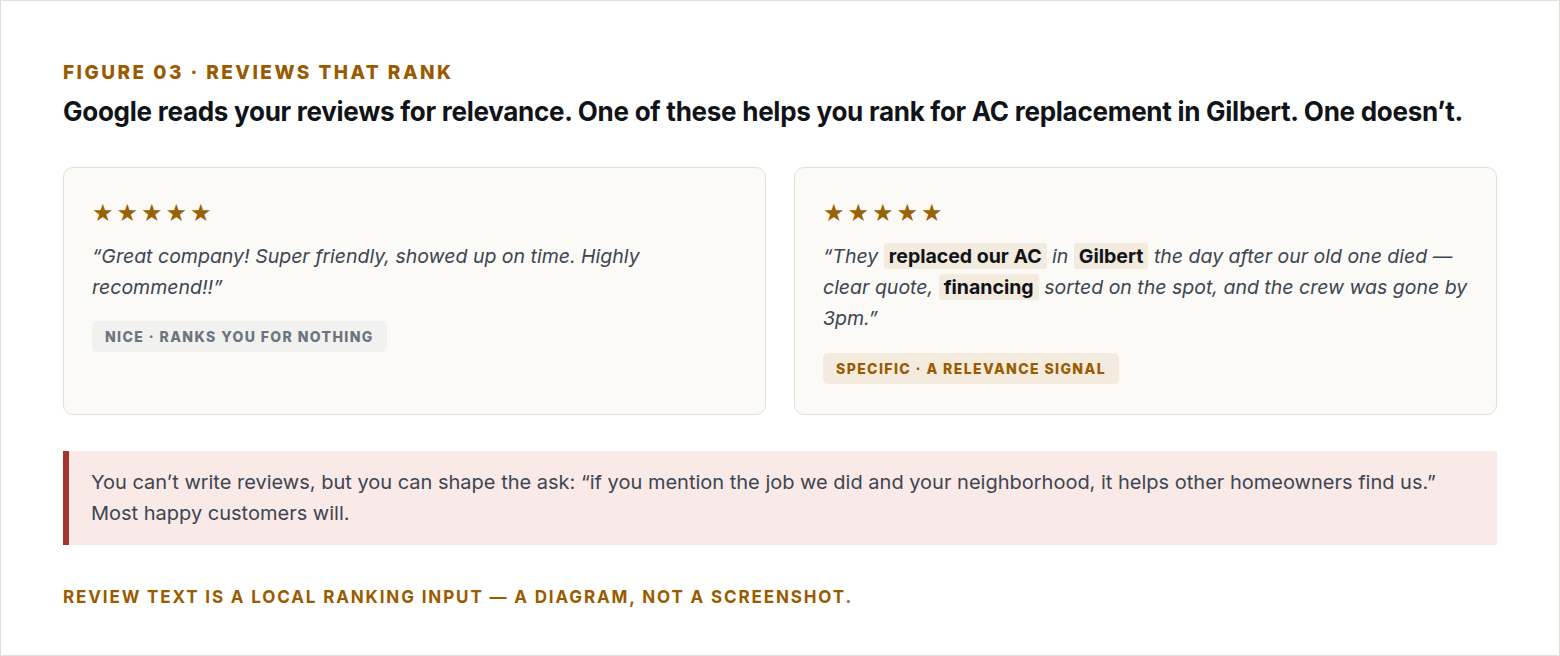
Reviews that rank
Reviews that rankSame star rating, different ranking value. The specific review is a vote for “AC replacement” and “Gilbert” at the same time.

You can’t write your reviews and shouldn’t try — but you can shape the ask. When the tech requests the review at close-out, one added sentence does the work: “if you mention what we did and your neighborhood, it helps other homeowners find us.” Most happy customers will oblige, because you’ve given them something easy to say. Do this for a season and your review profile becomes a suburb-by-suburb, service-by-service argument for your rankings that no competitor can copy or buy.

The brand trap

Nobody is searching for the equipment. They’re searching for the fix.

Dealer programs quietly shape HVAC websites around the manufacturer: a Carrier page, a Trane page, model numbers, SEER ratings, co-op badges everywhere. It photographs well at the dealer meeting. The problem is that homeowners don’t search for equipment — they search for what’s wrong and what it costs to make it right.
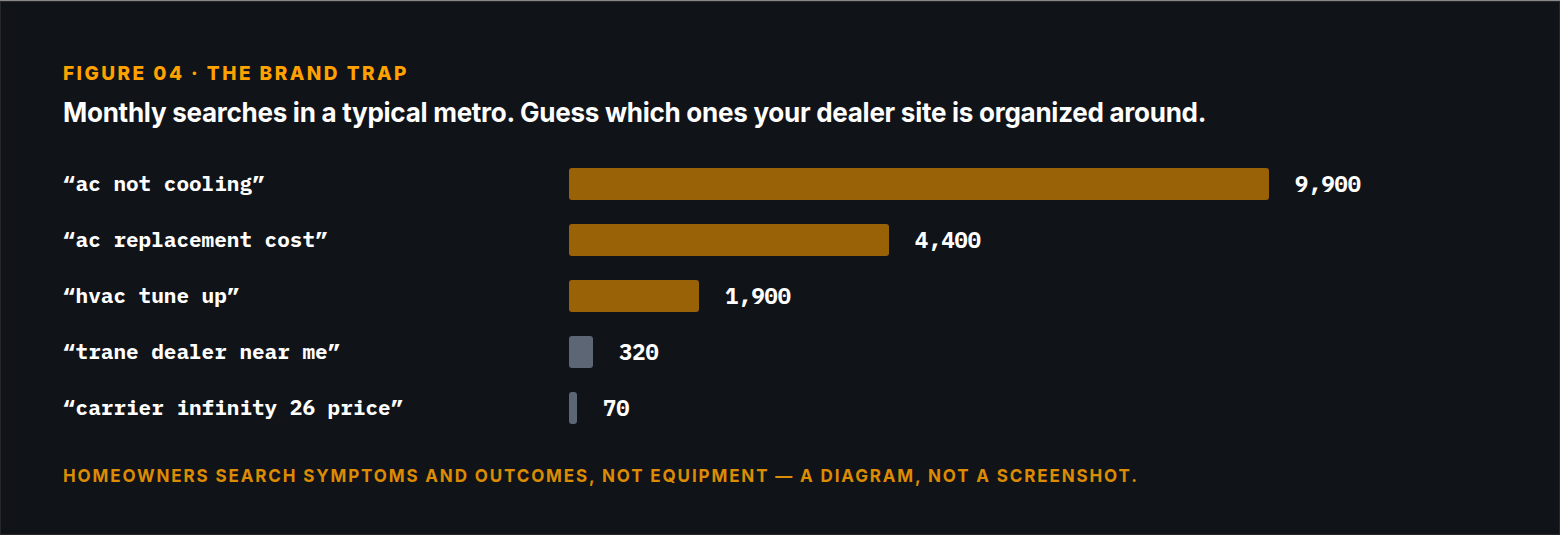
The brand trap
The brand trapThe demand is in symptoms and outcomes. The brand searches are a rounding error — and the manufacturer already ranks for them anyway.

The brand pages aren’t worthless — they close the buyer who’s already deep in research. But they’re the last five percent of the journey, and most dealer sites have built only that five percent, then wonder why the phone is quiet. The pages that fill a schedule are the ones this page keeps coming back to: symptoms, costs, timelines, financing — in your suburbs, in plain language. The Revenue Audit maps your site against how your metro actually searches and shows you, in dollars, which of the two you’ve been building.

The cold read

I already know three things about your website.

I haven’t seen it yet. I’m still usually right.

One: your seasonal content is published in the wrong season.

A new page needs weeks to be crawled, indexed and tested against competitors before it holds a position. Publishing heating content in October means you compete in January at the earliest. Everything you want to rank for in winter should have gone live in late summer, and everything you want for summer should ship in late winter.

Two: you have no maintenance plan page, and that is your best margin.

Maintenance agreements are recurring revenue, they smooth the shoulder seasons, and they are the single most valuable thing an HVAC company can sell. Most HVAC sites mention them in a footer link. There is real search volume for maintenance plans and almost no competition for it.

Three: nobody can find out what a system costs.

“How much does a new AC unit cost” is one of the highest-volume searches in your industry and almost nobody in the trade will answer it, because the answer is “it depends.” A page that gives honest ranges and explains what moves them will out-earn twelve blog posts, and it pre-qualifies every call that comes from it.

HVAC has two peaks a year and everyone shows up late for both.

The part nobody audits

Two peaks, two completely different buyers, one set of pages.

Summer is emergency cooling — hot house, immediate, price-insensitive, phone call. Winter is no-heat calls plus planned replacement, longer consideration, more research, more likely to fill a form and compare quotes.

Most HVAC sites use one voice for both, so the emergency pages read too slow and the replacement pages read too thin. Splitting them is unglamorous work and it moves conversion more than anything else I do on these accounts.

The math

What this has to be worth.

At an average system replacement, one or two extra installs a month covers the engagement comfortably. Maintenance plan signups compound on top of that and are the part most HVAC companies undervalue.

If those numbers do not work for your business, the audit will show it and I will tell you to spend the money elsewhere.

Straight answers

What HVAC owners ask me.

Because you are not slammed in April and October, and those are the months the audit is aimed at. Seasonal businesses do not have a traffic problem in peak season. They have a shoulder season problem, and it is solvable.

Almost certainly not. Homeowners do not search for SEER ratings; they search for what it costs and whether their house needs a bigger unit. Write for the question people actually type.

Then you are on a template shared by hundreds of other dealers, often with duplicate content and no control over structure. It is not always a disaster, but it needs looking at, and the audit will tell you whether it is worth leaving.

Find out what’s actually wrong.

Two weeks. $3,500. SEO, AI visibility, conversion, and the brand and product friction nobody else looks at.

Start with me within 60 days and half the fee comes off your first month. I work with three companies at a time.