
Skip to content

I know why your phone stopped ringing.
Let me prove it before you pay me a retainer.

Industries: HVAC, plumbing, roofing, remodeling. Thirty years in search, and a diagnosis first — because the last three people who sold you SEO never checked what was actually broken.

The cold read

I already know three things about your website.

I haven’t seen it yet. I’m still usually right.

One: your service area pages are thin or missing.

You serve fourteen towns and you have one page that lists them in a paragraph at the bottom. Most of the competitors beating you have fourteen pages. Not doorway junk — real pages with real local detail. It’s the most common expensive mistake I see in this industry.

Two: your Google Business Profile is doing more work than your website.

And nobody’s optimizing it. For a lot of home services companies the map pack is most of the game, and the agency you’re paying is writing blog posts about ‘5 Signs Your Furnace Needs Replacing’ instead.

Three: you're renting leads you might be able to earn.

You’re buying from an aggregator that outranks you for your own service in your own town. Sometimes that’s beatable and sometimes it isn’t — but almost nobody checks, and it gets treated as a permanent cost of doing business. That’s a question with an answer.

If any of that landed, you already know why a generic content package wasn’t going to help.

Where the calls start

Your next customer is standing in two inches of water.

Nobody browses for a plumber. Home services demand doesn’t build over weeks of research the way it does for software or cars — it detonates. A water heater fails at 9:40 on a Tuesday night, a breaker won’t reset, the AC dies in July, and someone who has never once thought about your trade pulls out a phone and types the problem into Google with the word “near me” attached.

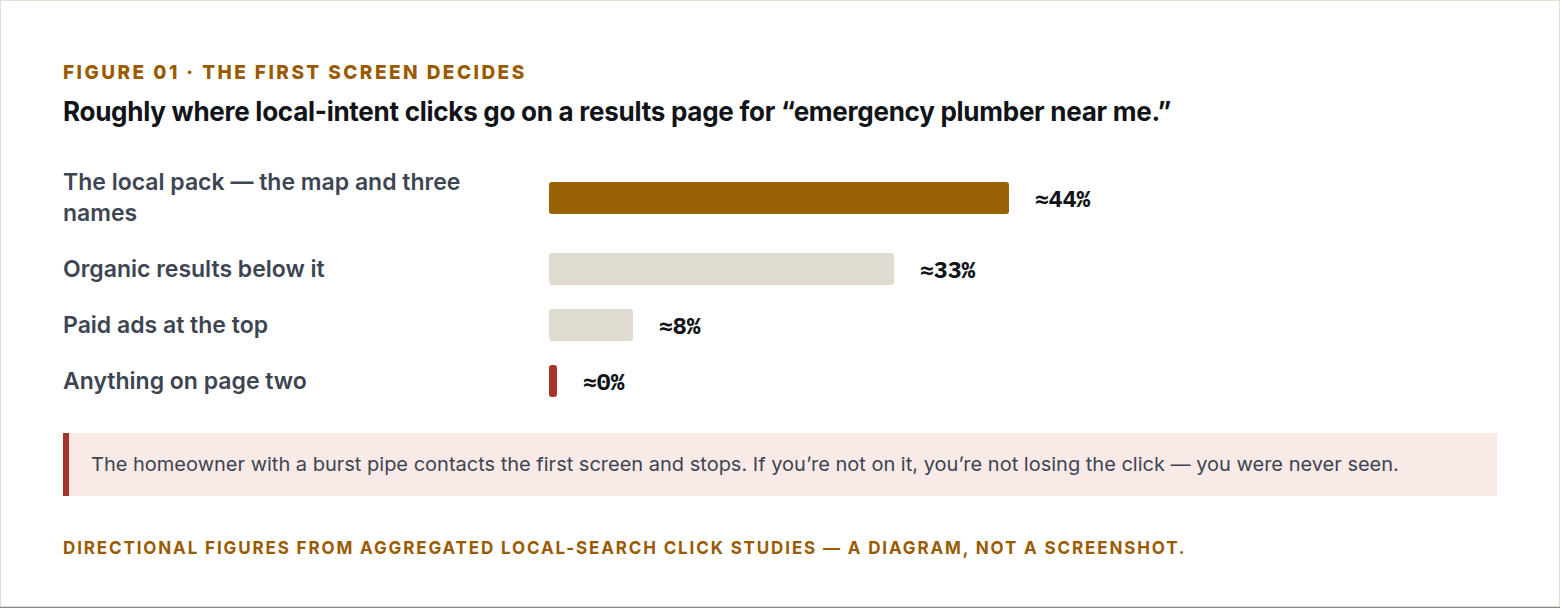
What happens in the next ninety seconds decides who gets the job. They are not comparing certifications. They are not reading your About page. They contact whoever the first screen of results puts in front of them — usually starting with the map — and they stop as soon as someone answers.
The first screen decides
The first screen decidesRoughly where local-intent clicks go. The local pack and the organic results under it take almost everything; page two is a rumor.

This is why I keep telling contractors that their real competitor isn’t the company with the better website — it’s whoever is findable at the moment of emergency. In my HVAC case study, ninety percent of booked jobs started as phone calls from exactly these searches. The work below is about being on that first screen, in every suburb you serve, when the water is rising.

The local pack

The map decides more jobs than your website does.

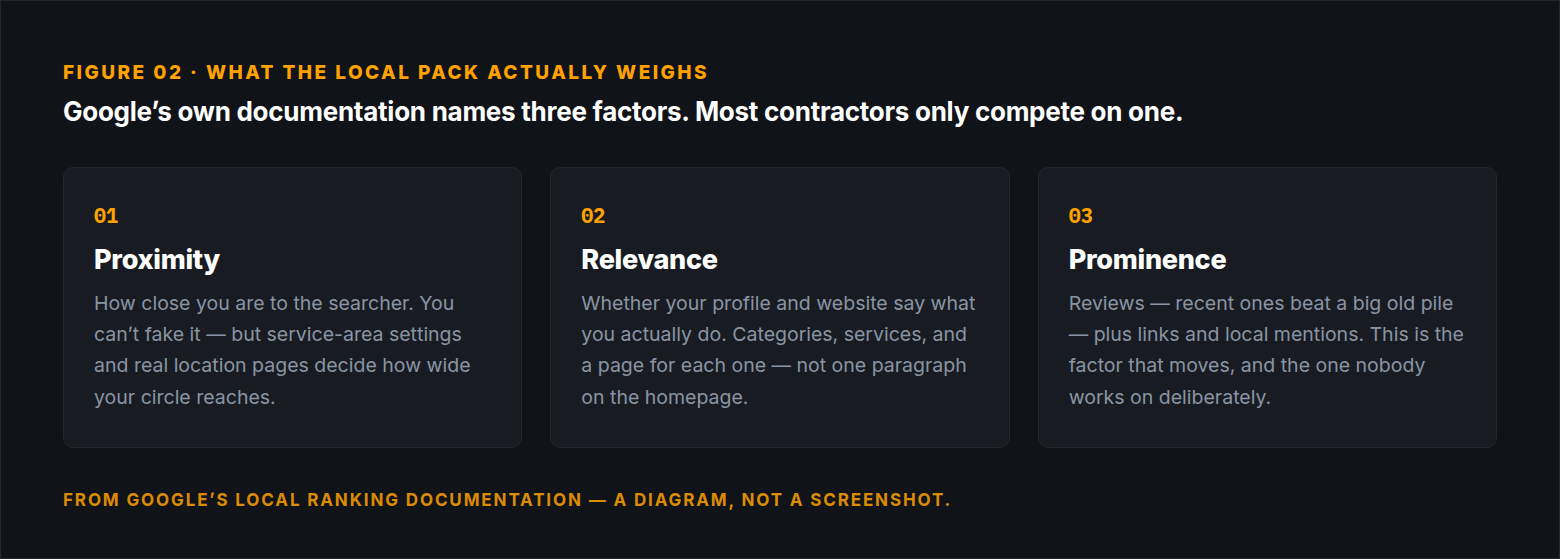
The three businesses Google shows on the map — the local pack — get the call more often than everything below them combined. Getting into that box is not luck and it is not a secret. Google publishes what it weighs: proximity, relevance, and prominence. What almost no contractor does is compete on all three deliberately.
What the local pack actually weighs
What the local pack actually weighsProximity you widen with real location pages. Relevance you earn with a page per service. Prominence is reviews — and recency beats volume.

The pattern I find in audits is always the same: the Google Business Profile was set up once, years ago, with two categories and a stock photo, and it still outperforms the website — which tells you how little the website is doing. Meanwhile reviews arrive whenever a customer happens to feel generous, because nobody on the crew asks at the moment the customer is happiest: the day the job is finished.

Fixing this is unglamorous. Categories that match what you actually sell. Services listed one by one. Photos from real jobs uploaded monthly. A review ask built into the close-out of every ticket. None of it is clever, which is exactly why the contractors who do it own the map in their metro — their competitors are all waiting for something more impressive to buy.

Service pages

One page for every service you sell. Yes, every one.

When I said your service pages are thin or missing, here is what I meant. Google ranks pages, not businesses. If drain cleaning, water heater replacement, repiping and slab leak repair all live in one paragraph on your homepage, then for each of those searches you are asking one overworked page to outrank competitors who built a dedicated page for it. It loses, politely, every time.
Anatomy of a service page that ranks
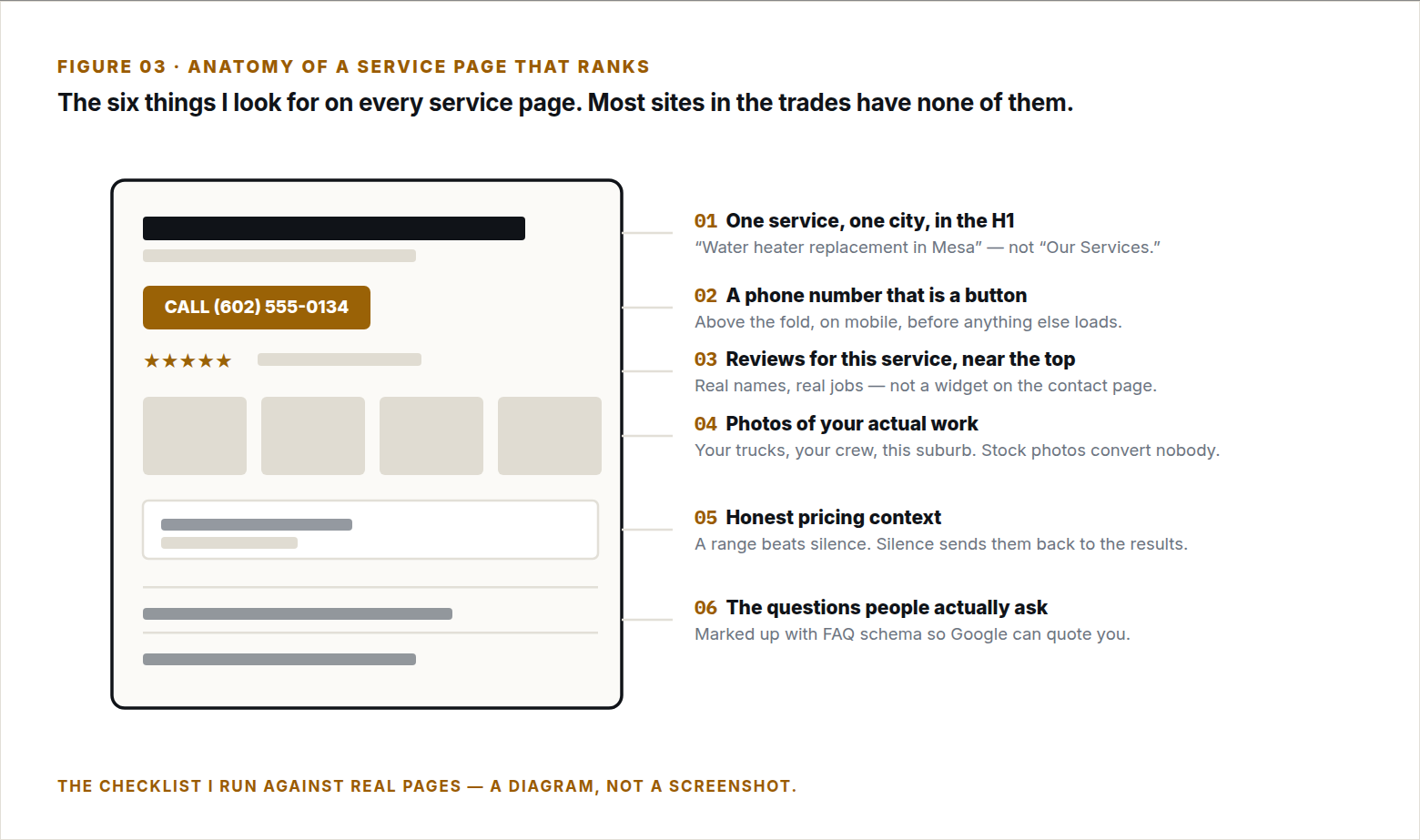
Anatomy of a service page that ranksThe six-point checklist I run against every service page in an audit. Most sites in the trades score zero for six.

Notice what isn’t on that list: word count. A service page doesn’t rank because it’s long; it ranks because it answers the exact search — one service, one area, with proof you’ve done it before and a way to reach you that works on a phone in a hallway with the water shut-off valve in the other hand.

Multiply this by geography. If your trucks work six suburbs, the searches happen suburb by suburb — “water heater replacement Mesa” is a different page-one than “water heater replacement Chandler.” Service pages times service areas is the real size of your website. For most contractors I audit, the honest number is thirty pages. They have five.

Pick your trade

The same leaks, trade by trade.

Every trade thinks its marketing problem is unique. After enough audits, I can tell you the leaks repeat — thin service pages, an unworked Business Profile, calls nobody measures — but where the money hides is different in each trade. Roofers lose it in storm season, plumbers lose it at 2 a.m., HVAC companies lose it in the shoulder months when the phones go quiet and everyone panics into buying ads.

Work in law instead of the trades? The same first-screen math applies with more zeros — start with the legal page, or see what nineteen hours of silence costs a firm in my intake teardown. And whichever trade is yours, the Revenue Audit starts the same way: your data, your market, and a list of exactly what’s leaking.

The math

What this has to be worth.

At $6,000 a month, this has to produce a few extra installs a month to make sense. That’s the entire argument, and it’s a math problem, not a sales pitch.

Run your own numbers: average job value, close rate, and how much of your market you’re currently invisible to. If it doesn’t clear the bar, the audit will show it and I’ll tell you to spend the money somewhere else.

Straight answers

What home services owners ask me.

Most home services companies have. Usually because they bought content when they needed local infrastructure, or because they hired someone who’d never worked on a service-area business and treated it like a national brand. The audit tells you which one happened to you.

Then you have a good business and a fragile one. Referrals are the first thing to dry up in a slow year — which is exactly when everyone starts SEO, and exactly when it takes longest to work.

I know. That’s usually a link and citation story rather than a website story, and it’s diagnosable. That’s what the audit is for.

Find out what's actually wrong.

Two weeks. $3,500. Yours to keep whatever you decide to do next.