Skip to content
Case study
Ecommerce · specialty outdoor

Google was crawling 340,000 URLs to find 11,000 products.

Faceted navigation had multiplied the catalog thirty times over. Most of the store had never been indexed at all, and the agency’s answer had been to write more category descriptions.

11,040products in the catalog
340k+crawlable URLs
3,110products ever indexed
7%of crawl reaching products

Read this first

An anonymized engagement.

Sector, catalog size, crawl figures and index coverage are real and come from their server logs and Search Console. The company name is not. The log analysis is reproducible by anyone with access to the same files, which is the point of publishing the method rather than the brand.

The complaint

Organic revenue had been flat for three years while the catalog had roughly doubled. Every new product line arrived, got photographed, got written up, went live, and then did nothing. The working theory inside the business was that the market had gotten more competitive. That is almost always the working theory, and it is almost always the least interesting explanation available.

The site was fast. The product pages were good — genuinely good, with real photography and specifications somebody who knew the category had written. There was nothing wrong with the thing itself. The problem was that Google was spending its entire budget somewhere else.

How eleven thousand becomes three hundred thousand

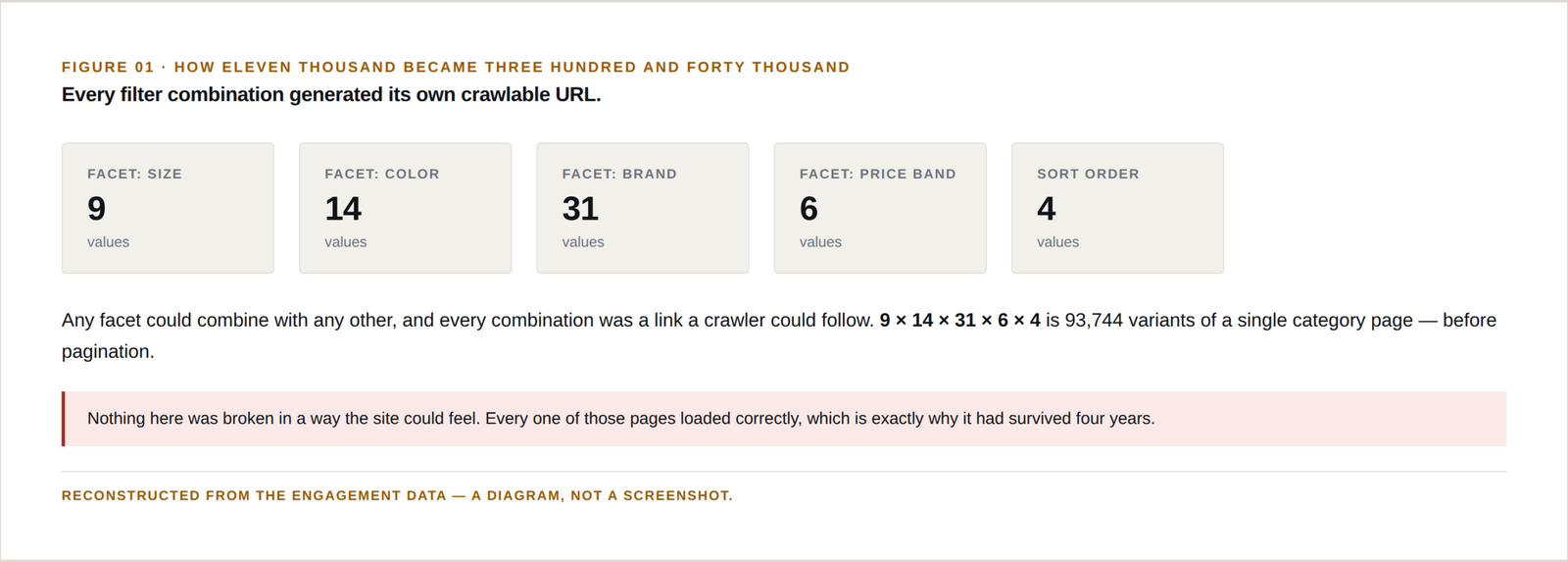
Five facet types with their value counts: size 9, color 14, brand 31, price band 6, sort order 4. Multiplied together they produce 93,744 variants of a single category page.
The facet mathEvery filter combination generated its own crawlable, linkable, indexable URL. Nine times fourteen times thirty-one times six times four is ninety-three thousand variants of one category page, before pagination.

This is the part that makes faceted navigation such a durable problem: nothing about it looks broken. Every one of those pages loaded. Every one returned a 200. Every one had products on it and a title tag and a working add-to-cart. A person clicking around the site would never find a fault, which is precisely why it had survived four years and two agencies.

What the logs said

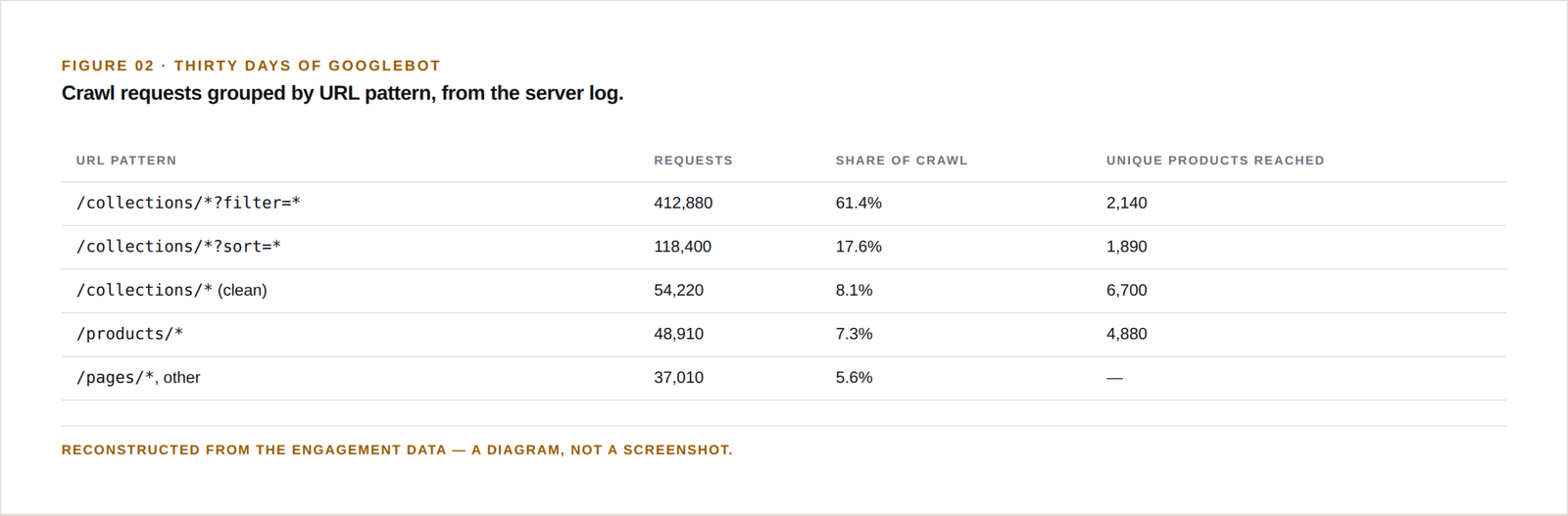
Table of crawl requests grouped by URL pattern. Filtered URLs took 61.4 percent of the crawl and sorted URLs 17.6 percent, while product URLs received 7.3 percent.
Thirty days of Googlebot, by URL patternSeventy-nine percent of the crawl went to filtered and sorted duplicates. Product pages — the only URLs on the site that can take money — got seven percent.

Nobody needed to take my word for any of this. It is a server log, it was on their own hosting, and the analysis is a afternoon with a text file and a spreadsheet. I have never understood why this is treated as an advanced technique. It is reading.

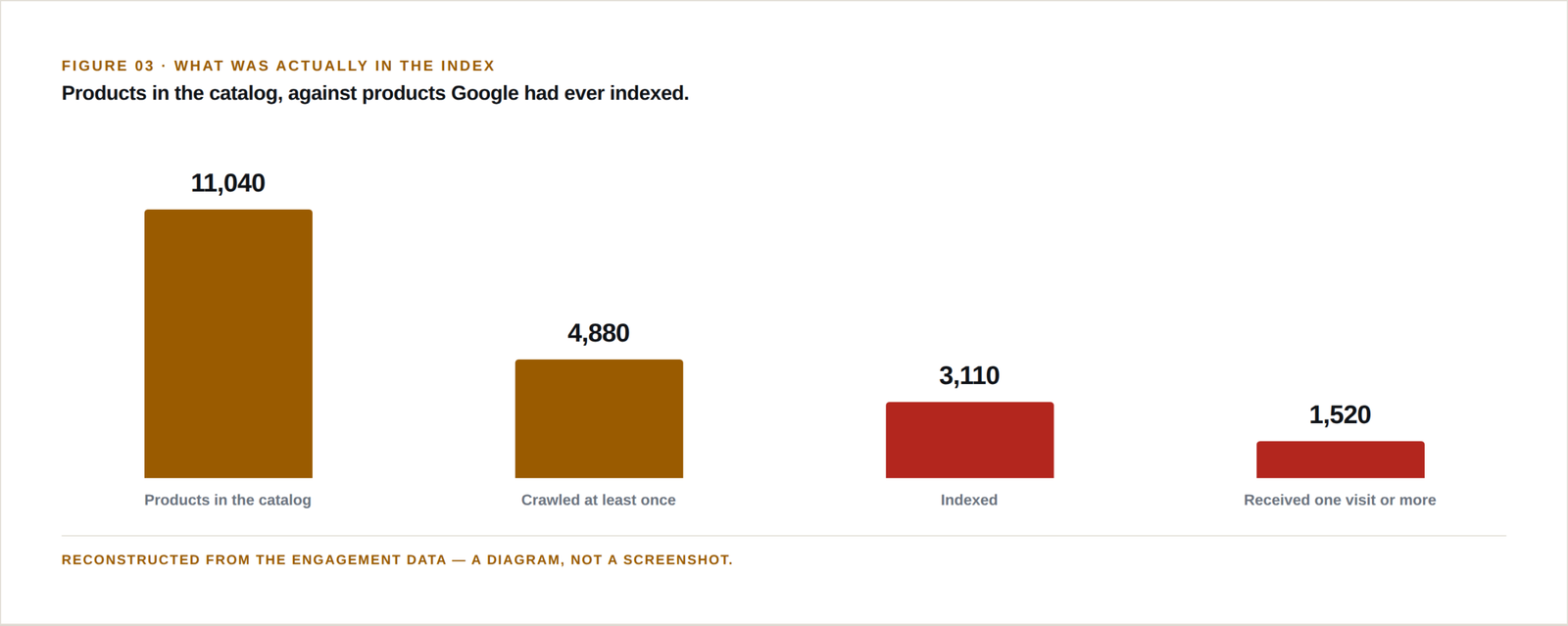
Bar chart: 11,040 products in the catalog, 4,880 crawled at least once, 3,110 indexed, and 1,520 having received one visit or more.
What was actually in the indexSeven thousand products the business had paid to photograph, describe, price and stock had never been seen by the search engine it was paying an agency to rank in.

They were not losing to competitors. Two thirds of the shop had never opened.

The fix, and how boring it was

  1. Block the facet parameters in robots.txt and add canonical tags pointing filtered views back at the clean category.
  2. Regenerate the sitemap from the product database rather than from the CMS’s idea of what pages exist.
  3. Add internal links from category pages to products that had no path in from anywhere — roughly four thousand of them had none at all.
  4. Leave the content alone. The product pages were already better than the ones ranking above them. They just could not be reached.
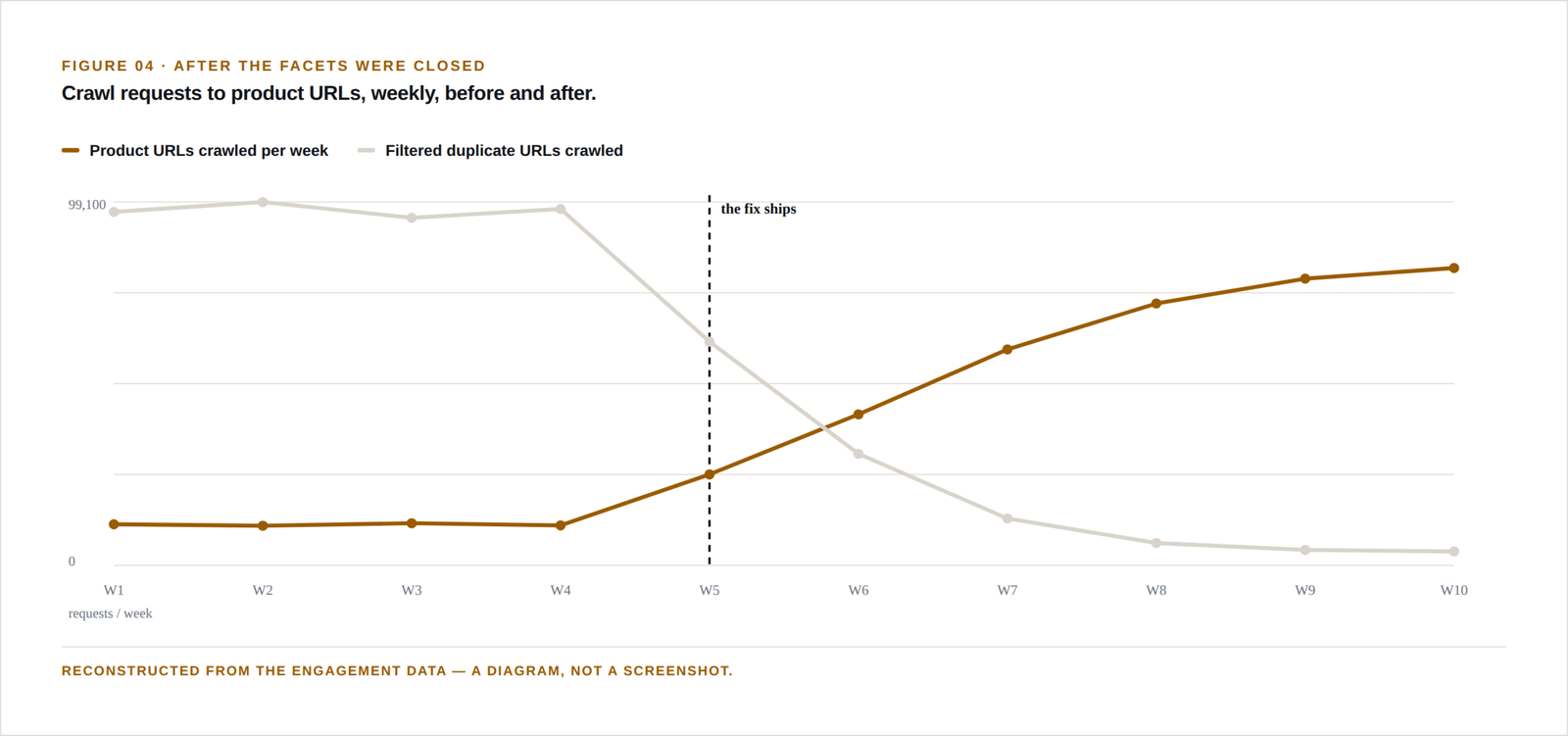
Line chart of weekly crawl requests over ten weeks. Product URL crawls rise from about 11,000 to 81,000 per week after the fix ships in week five, while filtered duplicate crawls fall from about 96,000 to under 4,000.
After the facets were closedNo new content and no new links. The same crawl budget, aimed at the pages that sell things.

What I would tell you to check

  1. Count the URLs in your sitemap, then count your products. If the first number is more than about one and a half times the second, find out why before you do anything else.
  2. Open Search Console and look at index coverage. Specifically the excluded tab, specifically “crawled — currently not indexed.”
  3. Ask your developer whether filter links are crawlable. The answer is usually yes, and usually nobody has ever asked.
  4. Get thirty days of server logs. They are free, they are already being written, and they will tell you what the search engine actually does rather than what you hope it does.

The audit is just the beginning

Why the best brands don't stop at the audit

The audit shows you what's broken. But the brands that own page one go deeper — they get the strategy, the execution, and the direct access to The SEO Savant that separates ranking from dominating.

01

Free SEO Audit ← YOU ARE HERE

27 checkpoints. Every leak, penalty risk and missed ranking found. Your unfair advantage starts here.

02

SEO Foundations

Full technical cleanup and on-page rebuild. Site speed, crawlability, structure and intent-matched pages — the fixes that move rankings in weeks, done for you.

03

Growth Engine

Monthly content engineered to rank and convert, plus authority links earned — never bought. Compounding visibility across search, maps and AI answers.

04

Savant Partnership

Direct access to The SEO Savant. Custom strategy, priority execution, monthly 1-on-1 growth sessions and full-funnel reporting. This is where categories get owned.

1:1 StrategyPriority ExecutionContent EngineAuthority Links
The Savant Advantage: Working with The SEO Savant isn't just about fixing a website. It's a system built from what actually ranks today — tested across niches, algorithm updates and AI search — with one person accountable for your growth. The free audit is your entry point.
Want this pointed at your site?

The Revenue Audit is two weeks and $3,500, and it is yours whatever you decide to do next — including taking it to somebody else.